

Table of Contents
ToggleClass 10th Mathematics Chapter 3 Notes
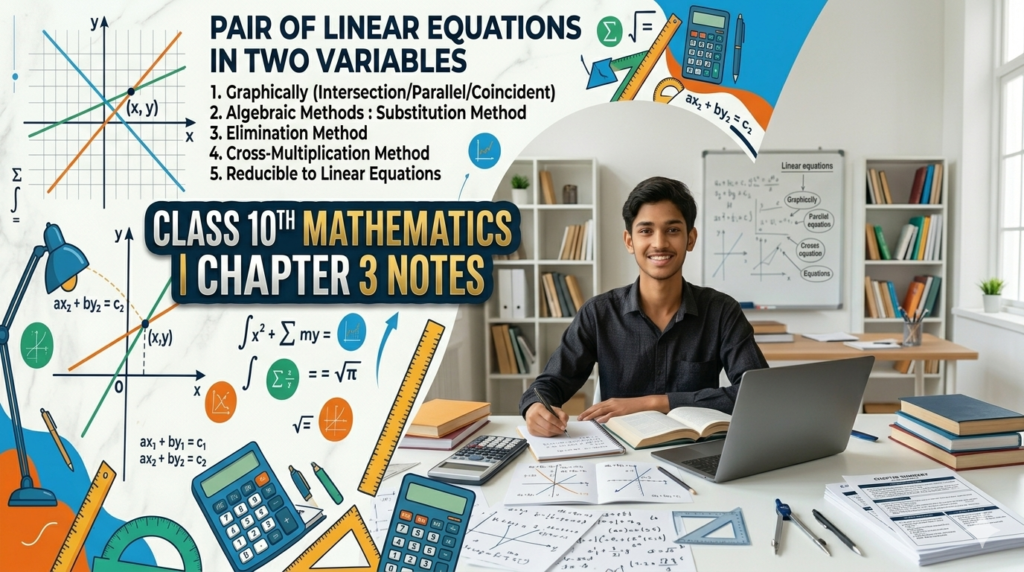
Mathematics is one of the most important subjects for Class 10 students because it helps build logical thinking and problem-solving skills. Chapter 3 of Class 10th Mathematics, Pair of Linear Equations in Two Variables, is a very important chapter for board examinations as well as competitive exams. Students often find this chapter interesting because it teaches different methods to solve equations and understand real-life mathematical situations.
In this chapter, students learn how to solve two linear equations having two variables. These equations can represent many practical situations such as finding the cost of items, speed and distance problems, age-related problems, and many more. The chapter mainly focuses on understanding the relationship between two equations and finding their common solution.
📘 Class 10th Mathematics Chapter 3 Notes
Welcome to these comprehensive Class 10th Mathematics Chapter 3 Notes, where we explore the concepts of pair of linear equations, graphical solutions, algebraic methods (substitution, elimination), consistency criteria, and real-life applications. This blog provides complete step‑by‑step explanations, solved NCERT examples, and important shortcuts — exactly what you need for exams. Let’s dive into the world of linear equations!
✨ 1. Forming Equations & Graphical Solutions
In Class 10th Mathematics Chapter 3 Notes, we learn to translate word problems into linear equations. Graphical method helps visualise intersection, parallel, or coincident lines. Let's solve two classic problems.
Solution: Let girls = x, boys = y.
Equations: \(x + y = 10\) and \(x - y = 4\). Plotting these lines, they intersect at (7, 3) → 7 girls, 3 boys. ✅
Solution: Let pencil = ₹x, pen = ₹y.
Equations: \(5x + 7y = 50\) and \(7x + 5y = 46\). Graphical intersection gives x = 3, y = 5 → Pencil = ₹3, Pen = ₹5.
From the graphs (shown in standard textbooks), we see that two lines cross at a unique point representing the solution. This graphical insight is the foundation of Class 10th Mathematics Chapter 3 Notes for understanding consistency.
📊 2. Types of Solutions: Intersecting, Parallel, Coincident
For a pair of equations \(a_1x + b_1y + c_1 = 0\) and \(a_2x + b_2y + c_2 = 0\):
- Unique solution (intersecting lines) ↔ \( \frac{a_1}{a_2} \neq \frac{b_1}{b_2} \) → consistent.
- No solution (parallel lines) ↔ \( \frac{a_1}{a_2} = \frac{b_1}{b_2} \neq \frac{c_1}{c_2} \) → inconsistent.
- Infinite solutions (coincident lines) ↔ \( \frac{a_1}{a_2} = \frac{b_1}{b_2} = \frac{c_1}{c_2} \) → consistent & dependent.
➤ \(5x - 4y + 8 = 0\) and \(7x + 6y - 9 = 0\) → \( \frac{5}{7} \neq \frac{-4}{6} \) → unique solution.
➤ \(9x + 3y + 12 = 0\) and \(18x + 6y + 24 = 0\) → \( \frac{9}{18} = \frac{3}{6} = \frac{12}{24} \) → coincident lines.
➤ \(6x - 3y + 10 = 0\) and \(2x - y + 9 = 0\) → \( \frac{6}{2} = \frac{-3}{-1} \neq \frac{10}{9} \) → parallel, no solution.
According to detailed Class 10th Mathematics Chapter 3 Notes, consistency check saves time during board exams. Always compare the ratios before solving.
🧩 3. Consistent vs Inconsistent Pairs (Solved)
Let’s examine given pairs from the exercise:
| Equations | Ratio Comparison | Conclusion |
|---|---|---|
| 3x+2y=5 ; 2x-3y=7 | a1/a2 = 3/2, b1/b2 = -2/3 → not equal | ✔ Consistent (unique solution) |
| 2x-3y=8 ; 4x-6y=9 | a1/a2 = 1/2, b1/b2 = 1/2, c1/c2 = 8/9 | ✘ Inconsistent (parallel) |
| (3/2)x+(5/3)y=7 ; 9x-10y=14 | a1/a2 = 1/6, b1/b2 = -1/6 → not equal | ✔ Consistent |
| 5x-3y=11 ; -10x+6y=-22 | all ratios = -1/2 | ✔ Consistent (coincident, infinite solutions) |
| (4/3)x+2y=8 ; 2x+3y=12 | a1/a2 = 2/3, b1/b2=2/3, c1/c2=2/3 | ✔ Coincident lines → consistent |
These examples are thoroughly covered in Class 10th Mathematics Chapter 3 Notes; practicing ratio method improves speed dramatically.
📈 4. Graphical Triangle with X-Axis
Consider equations \(x - y + 1 = 0\) and \(3x + 2y - 12 = 0\). Their graphs intersect at (2,3). The lines meet x‑axis at (-1,0) and (4,0). Thus the vertices of the triangle formed are (2,3), (-1,0), (4,0). This visualisation reinforces the geometrical meaning of a pair of equations.
⚙️ 5. Substitution Method – Easy & Powerful
One of the algebraic backbones of Class 10th Mathematics Chapter 3 Notes is the substitution method. Steps: (1) Express one variable in terms of the other from any equation. (2) Substitute into the second equation. (3) Solve and back-substitute. Let's solve typical problems.
From first: \(x = 14 - y\). Put in second: \((14 - y) - y = 4\) → \(14 - 2y = 4\) → \(2y = 10\) → \(y = 5\), then \(x = 9\). ✔️
\(s = 3 + t\). Substituting: \(\frac{3+t}{3} + \frac{t}{2} = 6\) → Multiply by 6: \(2(3+t) + 3t = 36\) → \(6 + 2t + 3t = 36\) → \(5t = 30\) → \(t = 6\), \(s = 9\).
From first: \(x = (1.3 - 0.3y)/0.2\). Substituting in second: \(0.4 \cdot \frac{1.3-0.3y}{0.2} + 0.5y = 2.3\) → \(2(1.3-0.3y) + 0.5y = 2.3\) → \(2.6 - 0.6y + 0.5y = 2.3\) → \(2.6 - 0.1y = 2.3\) → \(y = 3\), \(x = 2\). ✅
Also, equations like \(\sqrt{2}x + \sqrt{3}y = 0\) and \(\sqrt{3}x - \sqrt{8}y = 0\) give trivial solution \(x = 0, y = 0\) (consistent). The substitution method works for every linear pair.
📝 6. Important Word Problems (NCERT Based)
Class 10th Mathematics Chapter 3 Notes emphasises translating statements to equations. Below are must‑practice problems:
🏏 Cricket Team: Bats and Balls
7 bats + 6 balls = ₹3800 ; 3 bats + 5 balls = ₹1750. Find cost per bat & ball.
Let bat = ₹x, ball = ₹y. Equations: \(7x+6y=3800\), \(3x+5y=1750\). By substitution, we get \(x = 500, y = 50\). Hence bat ₹500, ball ₹50.
🚕 Taxi Charges Problem
Fixed charge + per km charge: For 10 km → ₹105, for 15 km → ₹155. Find fixed charge and per km rate.
Let fixed = ₹x, per km = ₹y: \(x+10y=105\), \(x+15y=155\). Solving, \(y=10, x=5\). For 25 km, charge = \(5+25×10 = ₹255\).
📖 Fraction Problem
A fraction becomes 9/11 if 2 is added to numerator & denominator; becomes 5/6 if 3 is added. Find the fraction.
Let fraction = \(x/y\). Equations: \(\frac{x+2}{y+2} = \frac{9}{11} \Rightarrow 11x - 9y = -4\) and \(\frac{x+3}{y+3} = \frac{5}{6} \Rightarrow 6x - 5y = -3\). Solving yields \(x=7, y=9\) ⇒ fraction = \(7/9\).
👨👦 Age Problem (Jacob & Son)
Five years hence, Jacob’s age will be three times his son’s age. Five years ago, Jacob’s age was seven times his son’s age. Find present ages.
Let Jacob = x, son = y. \((x+5)=3(y+5)\) ⇒ \(x-3y=10\); \((x-5)=7(y-5)\) ⇒ \(x-7y=-30\). Solving by substitution gives \(y=10, x=40\). So Jacob 40 years, son 10 years.
Supplementary angles problem: Larger exceeds smaller by 18°. Let angles be x & y. \(x+y=180\), \(x-y=18\) → solving gives \(x=99°, y=81°\).
📌 7. Constructing Linear Equations for Specific Conditions
Given equation \(2x + 3y - 8 = 0\), we can form another equation to get:
- Intersecting lines: choose \(2x - 7y + 9 = 0\) (since \(2/2 \neq 3/(-7)\)).
- Parallel lines: choose \(6x + 9y + 9 = 0\) ⇒ ratios: \(2/6=3/9 \neq -8/9\).
- Coincident lines: choose \(4x + 6y - 16 = 0\) ⇒ all ratios = 1/2.
These exercises are integral to Class 10th Mathematics Chapter 3 Notes and help master the condition of solvability.
🧠 8. Mixed Question: Finding 'm'
From second: \(x = (11-3y)/2\). Substituting into \(2x-4y=-24\): \(2(11-3y)/2 -4y = -24\) → \(11-3y-4y=-24\) → \(-7y=-35\) → \(y=5\), then \(x=-2\). Now \(5 = m(-2)+3\) → \(-2m=2\) → \(m=-1\). ✅
🔁 9. Coincident & Infinite Solutions (Exercise 4)
From NCERT exercise: \(x+y=5\) and \(2x+2y=10\) are coincident lines, thus infinite solutions. In contrast, \(x-y=8\) and \(3x-3y=16\) are parallel (inconsistent). The comparison of ratios instantly reveals the nature.
📌 Revision Checklist – Key Takeaways
These Class 10th Mathematics Chapter 3 Notes provide everything: graphical meaning, algebraic substitution, ratio tests, and word problems. Consistent practice will solidify your understanding for board exams. Remember the golden rules:
- For intersecting lines → unique solution.
- For parallel lines → no solution.
- For coincident lines → infinitely many solutions.
- Substitution method is systematic – avoid calculation errors.
⭐ In conclusion, these Class 10th Mathematics Chapter 3 Notes act as your ultimate revision companion. Master the methods, and you'll ace any question on linear equations! ⭐