Table of Contents
ToggleCTET December 2026 Mock Test – 150 MCQs with Answers and Explanations: Complete Practice Guide & Exam Schedule
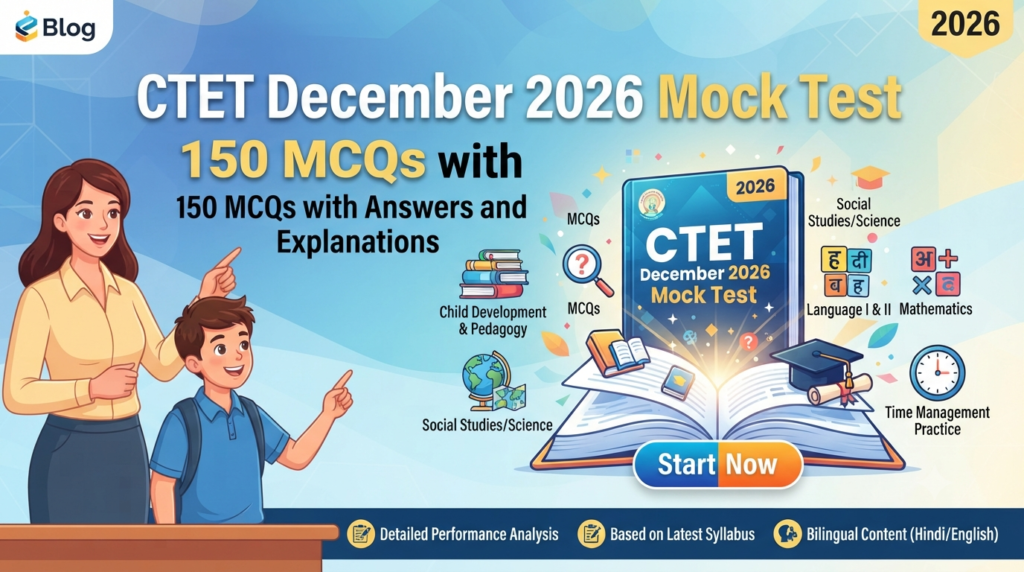
CTET December 2026 Mock Test – 150 MCQs with Answers and Explanations
Complete Exam-Pattern Practice Set, Verified CBSE Exam Dates (12 & 13 December 2026), OMR Strategy, and Official Links for Paper 1 & Paper 2 Aspirants.
📢 Confirmed CBSE Update: The Central Board of Secondary Education (CBSE) has officially scheduled the 22nd edition of the Central Teacher Eligibility Test (originally notified under the September 2026 cycle) for 12 December 2026 and 13 December 2026 across India in offline OMR mode. Advance Exam City Intimation Slips are expected roughly 15 days prior to the examination, while final Admit Cards will be issued 2 days before the test date.
With the 22nd edition of the Central Teacher Eligibility Test approaching fast, practicing with a full-length CTET December 2026 Mock Test has become the single most effective strategy for aspiring primary and upper-primary school teachers across India. Whether you are targeting Classes 1 to 5 (Paper 1) or Classes 6 to 8 (Paper 2), solving a structured set of 150 Multiple Choice Questions (MCQs) under real exam timing trains your brain to handle lengthy pedagogical statements, manage OMR bubble shading without errors, and eliminate guesswork anxiety.
In recent CBSE examination cycles, question papers have shifted noticeably away from direct rote-memory definitions toward classroom-based situational reasoning, National Education Policy (NEP) 2020 competency frameworks, and inclusive education scenarios. Simply reading theory books is no longer enough to cross the qualifying benchmark comfortably. Every serious candidate needs a well-calibrated CTET December 2026 Mock Test paired with detailed, concept-driven explanations so that every mistake turns into a permanent learning gain before exam day.
On this page at Mendhar.com, our academic team has compiled complete verified exam details, official schedule timelines, subject-wise 150-MCQ blueprint breakdowns, sample solved questions with explanations, and direct access resources to help you benchmark your readiness accurately.
CTET December 2026 – Complete Exam Overview & Verified Schedule
Before attempting a full 150-question practice paper, candidates must verify the official administrative schedule and examination structure released by CBSE on ctet.nic.in. Because over two million candidates appear nationwide in 20 languages, CBSE conducts the test in two distinct shifts over two days in pen-and-paper (OMR sheet) mode. Reviewing the exact dates below ensures you align your weekly revision cycles properly.
| Examination Parameter | Official Details & Status |
|---|---|
| Conducting Authority | Central Board of Secondary Education (CBSE), New Delhi |
| Examination Name & Edition | Central Teacher Eligibility Test (CTET) – 22nd Edition |
| Notification & Application Window | Confirmed: Notified on 11 May 2026 (Reopened 25 Aug – 01 Sep 2026; Correction closed 10 Sep 2026) |
| Confirmed CTET Exam Dates | 12 December 2026 & 13 December 2026 (Confirmed by CBSE Public Notice) |
| Advance Exam City Intimation Slip | Expected: ~15 Days Before Exam (Late November 2026) |
| Final Admit Card Release | Expected: 2 Days Before Allotted Exam Date (Around 10 December 2026) |
| Exam Mode & Question Format | Offline Pen-and-Paper (OMR Sheet) • 150 Objective MCQs per Paper |
| Total Marks & Duration | 150 Marks • 150 Minutes (2 Hours 30 Minutes) • Zero Negative Marking |
| Shift Timings | Shift 1: 09:30 AM – 12:00 PM | Shift 2: 02:30 PM – 05:00 PM |
| Answer Key & Result Declaration | To Be Announced (Expected within 3 to 5 weeks after examination) |
| Certificate Validity | Lifetime Validity across KVS, NVS, DSSSB, Central & State Schools |
Direct Official Links & CTET Practice Resources
Always rely exclusively on official CBSE portals when checking exam city allotments, downloading hall tickets, or verifying syllabus updates. Use the verified quick-access panel below to navigate directly to the official CTET portal or launch your CTET December 2026 Mock Test practice resources on Mendhar.com.
| Resource / Official Portal Activity | Quick Action |
|---|---|
| CTET 150 MCQs Full Mock Test & Answer Key (Mendhar Practice Hub) | START PRACTICE |
| CBSE CTET Official Website (Public Notices & Exam Schedule) | VISIT OFFICIAL SITE |
| CTET Exam City Intimation & Admit Card Login Portal (Active on Release) | CHECK STATUS |
| Official CTET Information Bulletin & Syllabus PDF (Paper 1 & 2) | DOWNLOAD NOW |
Step-by-Step Guide: How to Attempt the 150-MCQ Mock Test & Download Admit Card
To extract maximum value from your preparation, treat every practice paper like the actual CBSE examination hall. Follow this structured two-phase procedure—first for simulating the 150-question OMR test at home, and second for retrieving your official hall ticket once CBSE activates the link.
Phase A: Simulating the 150-MCQ Mock Test Under Real Exam Rules
- Set a Strict 150-Minute Countdown Timer: Sit at a quiet study desk during your actual exam shift window (either 09:30 AM – 12:00 PM or 02:30 PM – 05:00 PM). Keep mobile notifications off.
- Use a Printed 150-Bubble OMR Practice Sheet: Because CTET is conducted offline, shading 150 circles with a black or blue ballpoint pen takes 12 to 15 minutes. Practicing on an OMR sheet prevents roll-number errors and misalignment under pressure.
- Follow Ideal Section-Wise Time Allocation: Dedicate roughly 25 minutes to Child Development & Pedagogy (30 Qs), 25 minutes each to Language I and Language II (30 Qs each), and 55–60 minutes to Mathematics/EVS or Mathematics & Science / Social Studies (60 Qs), leaving 15 minutes for final review and unanswered bubbles.
- Attempt All 150 Questions Strategically: Since CBSE awards +1 mark per right answer and applies zero negative marking, eliminate impossible options and mark the most learner-centric choice for every question before time expires.
- Audit Explanations Immediately After Scoring: Do not merely count your score out of 150. Read the detailed explanation for every wrong or guessed MCQ to identify weak NCERT chapters or pedagogical concepts.
Phase B: How to Download CTET December 2026 City Slip & Admit Card
- Visit the Official Portal: Open your browser and navigate to https://ctet.nic.in/.
- Locate the Candidate Activity Link: On the homepage, click on the link titled "Download Pre-Admit Card / Exam City Intimation" (available ~15 days prior) or "Download Admit Card for CTET 22nd Edition" (available 2 days prior).
- Enter Login Credentials: Type your Application Number, select your Date of Birth, and enter the case-sensitive Security Pin displayed on screen.
- Verify & Print Two Copies: Check your name, photograph, signature, chosen languages (Language I & II), and exact centre address. Print two clear copies on A4 paper for exam day.
150-MCQ Exam Blueprint, Qualifying Criteria & Exam-Day Instructions
A reliable CTET December 2026 Mock Test strictly mirrors the official CBSE question distribution. Both Paper 1 (Primary Stage: Classes I–V) and Paper 2 (Elementary Stage: Classes VI–VIII) consist of 150 objective questions worth 1 mark each. Half of almost every subject section tests content knowledge rooted in NCERT textbooks (Classes 1 to 8), while the remaining half evaluates subject-specific pedagogical understanding.
| Paper Level | Section / Subject Breakdown | Total MCQs | Total Marks |
|---|---|---|---|
| Paper 1 (Classes 1 to 5) |
1. Child Development & Pedagogy (30 Qs) 2. Language I – Compulsory (30 Qs) 3. Language II – Compulsory (30 Qs) 4. Mathematics (30 Qs) 5. Environmental Studies / EVS (30 Qs) |
150 | 150 |
| Paper 2 (Classes 6 to 8) |
1. Child Development & Pedagogy (30 Qs) 2. Language I – Compulsory (30 Qs) 3. Language II – Compulsory (30 Qs) 4. Mathematics & Science OR Social Studies / Social Science (60 Qs) |
150 | 150 |
Minimum Qualifying Marks & Mandatory Exam-Hall Documents
- General / Unreserved Qualifying Score: Candidates must score at least 60% (90 out of 150 marks) to be declared CTET qualified by CBSE.
- Reserved Category Relaxation (SC/ST/OBC/PwD): Candidates belonging to reserved categories generally require 55% (82 out of 150 marks) as per prevailing reservation norms of the respective appointing authority.
- Documents Required at Exam Centre: Printed copy of the official CTET Admit Card, one original valid Photo ID Proof (Aadhaar Card, Passport, PAN Card, Voter ID, or Driving Licence), and good-quality blue/black ballpoint pens.
- Strict Gate Closure Rule: Entry closes sharply at 09:30 AM for Shift 1 and 02:30 PM for Shift 2. Candidates are instructed to report at least 90 to 120 minutes early for biometric verification.
Sample Solved MCQs with Explanations & High-Scoring Preparation Strategy
To help you understand the exact analytical standard expected in a CTET December 2026 Mock Test, review the five representative questions below covering Child Development & Pedagogy, Environmental Studies, Mathematics Pedagogy, and Language Teaching. Notice how every correct option prioritizes child-centered discovery, inclusivity, and conceptual understanding over passive memorization.
Q1. (Child Development & Pedagogy) According to Lev Vygotsky’s socio-cultural theory, what is the most effective role of a teacher when a student struggles to solve a multi-step problem independently?
(A) Provide the complete written solution for memorization | (B) Offer calibrated hints and guiding questions within the learner’s Zone of Proximal Development | (C) Group the student with lower-achieving peers permanently | (D) Reduce the syllabus difficulty permanently
Explanation: Vygotsky emphasized scaffolding—temporary, adjustable support provided by a More Knowledgeable Other (MKO) inside the learner’s Zone of Proximal Development (ZPD). Giving hints rather than direct answers builds independent cognitive competence.
Q2. (NEP 2020 & Assessment) Under the National Education Policy (NEP) 2020, school-based assessment in elementary classes should primarily shift toward:
(A) High-stakes year-end summative memorization tests | (B) Formative, competency-based evaluation that promotes critical thinking | (C) Weekly ranking of students on public notice boards | (D) Standardized rote recall drills
Explanation: NEP 2020 explicitly recommends transforming assessment from summative testing of rote facts to regular, formative, competency-based evaluation (supported by PARAKH) that diagnoses learning gaps and nurtures higher-order thinking.
Q3. (Environmental Studies – Paper 1) Why does the NCERT Class 3 to 5 EVS curriculum integrate Science, Social Science, and Environmental Education into a single theme-based subject?
(A) To reduce the weight of school bags only | (B) Because young children perceive their surroundings holistically rather than in compartmentalized disciplines | (C) Because primary teachers do not study science | (D) To eliminate practical field observations
Explanation: As outlined in NCF 2005 and NCERT EVS textbooks, children at the primary stage look at their environment as an interconnected whole (Family, Food, Water, Shelter, Travel) rather than separate academic silos.
Q4. (Mathematics Pedagogy) A Class 4 student writes "400 + 25 = 40025". What is the most constructive pedagogical response by the teacher?
(A) Mark the notebook with a red cross and assign 20 punishment sums | (B) Use concrete Dienes blocks or place-value strips to help the child visualize hundreds, tens, and ones | (C) Tell the child to memorize addition tables | (D) Ignore the error until Class 5
Explanation: Student errors are windows into how children think. Concatenating 400 and 25 into 40025 reveals a misconception in place value, which is best remediated through hands-on manipulatives like Dienes blocks.
Q5. (Language Pedagogy) In a multilingual Indian primary classroom, using learners’ home languages as a bridge while introducing a second language is known as:
(A) Linguistic interference | (B) Multilingualism as a pedagogical resource | (C) Grammar-translation restriction | (D) Subtractive bilingualism
Explanation: Both NCF and NEP 2020 treat a child’s mother tongue as a cognitive asset. Leveraging home languages fosters emotional security, faster vocabulary transfer, and deeper comprehension.
Proven Preparation Tips to Score 120+ in CTET December 2026
- Master NCERT Line-by-Line: Read NCERT Classes 3–5 (EVS & Maths) for Paper 1 and NCERT Classes 6–8 (Science/Maths or History, Geography & Civics) for Paper 2.
- Apply Positive Tag-Words in Pedagogy: Options featuring active exploration, peer learning, inclusivity, real-life context, and diagnostic feedback are almost always right; options promoting rote memorization, punishment, labeling, or rigid control are wrong.
- Solve at Least 10 Full-Length Papers: Take two full 150-MCQ tests per week until December 2026 and maintain an error notebook for recurring weak topics.
Frequently Asked Questions (FAQs) – CTET December 2026
1. What are the official exam dates for CTET December 2026?
CBSE has officially announced that the 22nd edition of CTET will be conducted on 12 December 2026 and 13 December 2026 across designated examination centres nationwide.
2. How many questions and marks are in each CTET paper?
Both Paper 1 and Paper 2 consist of 150 Multiple Choice Questions (MCQs) carrying 1 mark each, for a total of 150 marks.
3. Is there any negative marking in CTET December 2026?
No. There is zero negative marking for wrong or unattempted answers, so candidates should attempt all 150 questions.
4. Will the CTET December 2026 exam be online or offline?
The examination will be conducted in offline pen-and-paper mode using OMR answer sheets.
5. What is the exact duration and shift timing for CTET 2026?
Each shift lasts 2 hours and 30 minutes (150 minutes). Shift 1 runs from 09:30 AM to 12:00 PM, and Shift 2 runs from 02:30 PM to 05:00 PM.
6. When will CBSE release the Exam City Slip and Admit Card?
Advance Exam City Intimation Slips are expected roughly 15 days before the test (late November 2026), while final Admit Cards are released 2 days prior to the exam date.
7. What is the minimum passing score for CTET?
General category candidates must score at least 60% (90/150 marks), whereas reserved category candidates (SC/ST/OBC/PwD) generally qualify at 55% (82/150 marks).
8. Why is practicing a CTET December 2026 Mock Test with explanations essential?
Detailed explanations clarify why three distractors fail pedagogical principles, helping candidates master assertion-reason and classroom-scenario questions faster.
9. How long is a CTET qualifying certificate valid?
A CTET qualifying certificate holds lifetime validity for all categories, and there is no restriction on the number of attempts to improve your score.
10. Which books are best alongside online mock tests for CTET?
NCERT textbooks from Classes 3 to 8, official CBSE previous year question papers, and NEP 2020 / NCF 2005 summary notes form the strongest foundation.
Final Takeaway & Next Steps
Cracking the 22nd edition of CTET on 12–13 December 2026 comes down to disciplined OMR practice, strong NCERT fundamentals, and child-centered pedagogical thinking. Bookmark Mendhar.com for daily subject-wise quizzes, admit card alerts, and complete solved practice sets.
CHECK OFFICIAL CTET PORTAL