Table of Contents
ToggleJNVST Class 6 Syllabus 2027: Latest Changes, New EVS Section, Maths Topics & Complete Exam Pattern
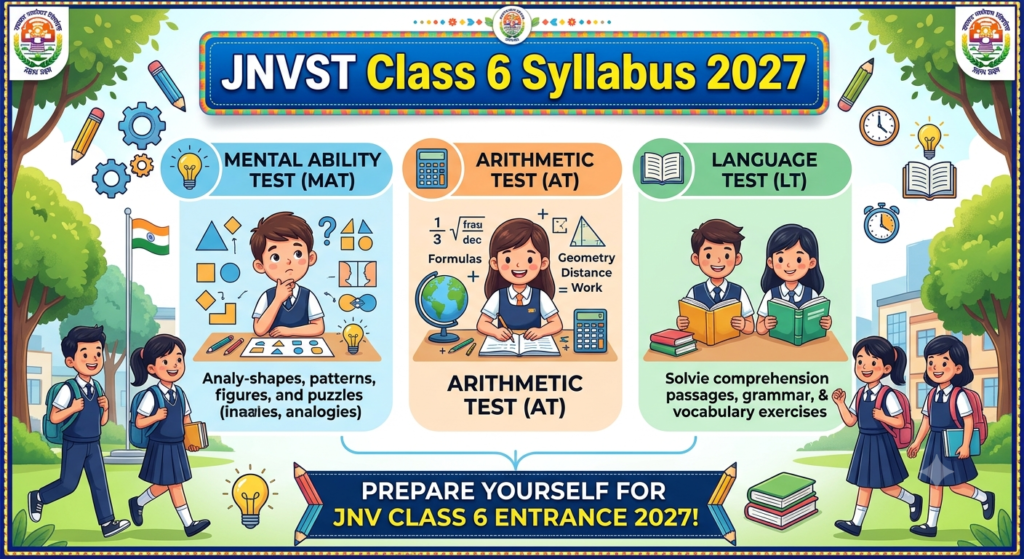
JNVST Class 6 Syllabus 2027: Latest Changes & New EVS Topics
Are you preparing your child for admission to Jawahar Navodaya Vidyalaya (JNV) in Class 6? Then there is an important syllabus update you should know about before choosing books, solving mock tests or following an old preparation strategy.
For the 2027 JNVST Class 6 exam, the most critical change is the addition of Environmental Studies (EVS), which is now combined with Mental Ability to form the first section of the paper. The total number of questions remains 80, but the internal structure has been adjusted: Mental Ability questions have been reduced from the previous 40 to 20, and the vacated slots have been filled by EVS.
📝 Exam Pattern and Section Breakdown
The exam is still conducted in offline OMR format, with a total duration of 2 hours and no negative marking (each correct answer earns 1.25 points).
| Section | Question Count | Marks | Time |
|---|---|---|---|
| Mental Ability + EVS | 20 + 20 | 25 + 25 | 60 minutes |
| Arithmetic | 20 | 25 | 30 minutes |
| Language | 20 | 25 | 30 minutes |
| Total | 80 | 100 | 120 minutes |
Minimum Qualifying Marks: To pass the selection, you must achieve certain minimum scores in each section. Typically, the combined Mental Ability + EVS section requires 14 points, while Arithmetic and Language each require 7 points (please refer to the latest official prospectus for accuracy).
🆕 New EVS Section Essentials
The EVS section comprises 20 questions (25 marks), primarily testing candidates' understanding of their surroundings and basic common sense. The question format is usually 15 standalone multiple-choice questions + 1 passage with 5 associated questions. The content is organized around four core areas:
🌿 The Natural World
Transportation, rivers, mountains, plants and animals (including aquatic and terrestrial), natural disasters, housing types, water cycle, etc.
🧑⚕️ The Human Body
Food and nutrition, hygiene and cleanliness, super senses, and basic knowledge of internal systems such as digestion, respiration, and circulation.
🔬 Science in Daily Life
Food preservation, water and air pollution, water and soil conservation, etc.
🏛️ Social Surroundings
Indian states and capitals, national symbols, festivals, seasons, forests, crops, clothing and fibers, etc.
📐 Other Section Changes and Focus
Mental Ability (MAT)
Although the question count has been reduced to 20, the types of questions have been streamlined. The 2027 syllabus clearly lists 5 question types, with 4 questions each: Pattern Completion, Figure Series Completion, Geometrical Figure Completion, Mirror and Water Imaging, and Embedded Figures.
Arithmetic
The syllabus has been consolidated into 9 major topics, including number system, simplification, fractions, factors and multiples, measurement (explicitly including unit conversion), lines and angles (explicitly including direction and mapping), data interpretation (explicitly including tables and pictographs), perimeter and area, etc.
Language
The structure remains unchanged, typically consisting of 4 reading comprehension passages (with 5 questions each), with a total of 20 questions testing grammar, vocabulary, and comprehension abilities.
💡 Preparation Recommendations
- Given the structural changes, the previous strategy of "focusing only on reasoning and math" is no longer sufficient.
- It is recommended to allocate approximately 20–30 minutes daily specifically for EVS, emphasizing understanding of natural phenomena and life common sense in the textbook rather than rote memorization.
- Simultaneously, ensure proficiency in the 5 core question types of Mental Ability and avoid wasting time on removed question types (such as odd-one-out, analogies, etc.).
- In the final sprint phase, be sure to use mock exams based on the latest 2027 syllabus for practice to adapt to the new time allocation.
📅 Note: The specific exam date is November 28, 2026, and registration typically closes in early August. Please refer to the prospectus on the Navodaya Vidyalaya Samiti (NVS) official website for final details.
Frequently Asked Questions (FAQs) About JNVST Class 6 Syllabus 2027
1. What is the JNVST Class 6 Syllabus 2027?
The JNVST Class 6 Syllabus 2027 refers to the subjects, topics and skills assessed in the Jawahar Navodaya Vidyalaya Selection Test for admission to Class 6. Students preparing for the examination should focus on Mental Ability, Arithmetic and Language, while also checking the reported inclusion of Environmental Studies (EVS) in the revised examination pattern. Always consult the applicable official NVS prospectus to confirm the final syllabus.
2. What is the latest change in the Navodaya Class 6 syllabus for 2027?
The major reported change for the 2027–28 admission session is the introduction of a separate Environmental Studies component containing 20 questions. The reported Mental Ability section has been reduced from 40 to 20 questions. This makes it important for students to revise their preparation strategy and check whether their study books and mock tests reflect the latest pattern.
3. Has Environmental Studies been added to the JNVST Class 6 examination?
Environmental Studies has been reported as a new component in the revised examination pattern. The proposed section covers topics related to nature, the human body, everyday science, environmental conservation and social surroundings. Students should verify these details against the official admission prospectus before relying on them as final examination requirements.
4. How many questions are there in the JNVST Class 6 entrance examination?
The reported revised pattern contains 80 objective-type questions carrying a total of 100 marks. The reported distribution is 20 Mental Ability questions, 20 EVS questions, 20 Arithmetic questions and 20 Language questions. Candidates should confirm the final distribution in the official notification for their admission session.
5. What is the total duration of the JNVST Class 6 examination?
The reported examination duration is two hours, or 120 minutes. Under the revised pattern, the Mental Ability and EVS components share a 60-minute block, while Arithmetic and Language have separate 30-minute blocks. Students should practise according to the timings and instructions specified in the official prospectus.
6. What is the marking scheme for JNVST Class 6 2027?
Under the reported pattern, each correct answer carries 1.25 marks, making 80 correct answers worth 100 marks. The reported scheme does not include negative marking for incorrect answers. Students should still read the examination instructions carefully because the final prospectus is the authoritative source for marking rules.
7. Which topics are included in the Mental Ability Test?
Mental Ability preparation generally includes figure matching, pattern completion, figure series, geometrical figure completion, mirror images, water images and embedded figures. These questions assess observation, visual reasoning and problem-solving abilities. Students should practise a variety of diagrams and learn to identify patterns without spending too much time on a single question.
8. Which Mathematics topics should students prepare for Navodaya Class 6 admission?
Important Arithmetic topics include number systems, addition, subtraction, multiplication, division, factors, multiples, fractions, measurement, simplification, perimeter, area, angles and data interpretation. Students should check the revised official topic list before excluding topics found in older preparation books. Regular practice with numerical problems can improve both speed and accuracy.
9. Which topics are included in the EVS syllabus?
The reported EVS topics cover the natural world, the human body, science in everyday life and social surroundings. Students may need to revise plants, animals, rivers, mountains, food, hygiene, water conservation, pollution, transportation, national symbols, states and capitals, seasons and other primary-level environmental and general-awareness concepts. The precise examinable list should be confirmed from the official syllabus.
10. What is the Language Test in JNVST Class 6?
The Language Test assesses a student’s ability to read and understand passages. The reported pattern contains 20 questions, commonly organised around four passages with five questions each. Students should practise identifying the main idea, locating information, understanding vocabulary from context and answering comprehension questions accurately.
11. Which books are best for preparing for the Navodaya Class 6 entrance exam?
Students should begin with their primary-school textbooks, particularly Mathematics, language and Environmental Studies books where relevant. A reliable JNVST preparation guide and mock-test book aligned with the applicable syllabus can provide additional practice. Before purchasing a guide, check its publication date, coverage of the revised pattern and accuracy of the answer explanations.
12. Can students prepare for JNVST Class 6 using previous-year question papers?
Yes. Previous-year question papers are useful for understanding question styles, practising calculations and improving reasoning skills. However, old papers may follow a different examination pattern. Students should therefore use them alongside updated practice sets and should not assume that every question distribution or topic remains unchanged.
13. How many hours should students study daily for JNVST Class 6?
A student can begin with approximately two hours of focused preparation daily, alongside regular schoolwork. For example, allocate 30 minutes each to Mental Ability, EVS and Arithmetic, 20 minutes to Language and 10 minutes to revision. Students can adjust this routine according to their learning needs, school timetable and progress.
14. Is there negative marking in the Navodaya Class 6 entrance examination?
The reported JNVST 2027 pattern has no negative marking. Nevertheless, students must confirm this rule in the applicable official prospectus. They should learn to manage their time carefully, read every question properly and follow the instructions for marking answers on the OMR sheet.
15. How can students improve their Mental Ability scores?
Students can improve by practising figure series, matching exercises, mirror images and embedded figures every day. Begin with simple questions, understand the underlying pattern and gradually increase the difficulty. Reviewing incorrect answers is particularly important because it helps students recognise common mistakes and improve their reasoning speed.
16. How can students prepare for the EVS section effectively?
Students should revise primary-level textbooks, prepare short notes and practise multiple-choice questions on the natural environment, human health and everyday science. Connecting textbook concepts with daily life can make learning easier. Students should also use EVS mock tests that match the confirmed examination syllabus rather than relying solely on general-knowledge question banks.
17. What is the eligibility age for JNVST Class 6 admission in 2027?
The age requirement and permitted date-of-birth range are specified in the official admission notification for each session. Parents should check the 2027–28 prospectus rather than relying on age limits quoted in previous admission cycles. Other conditions, including schooling and district-related eligibility, must also be checked before submitting an application.
18. When will the JNVST Class 6 examination be conducted for the 2027–28 session?
The examination date should be confirmed through the official Navodaya Vidyalaya Samiti admission notification. Parents should regularly check the official website for the application deadline, examination schedule, admit-card announcements and other instructions. Avoid relying on unverified dates circulated on social media.
19. Where can students download the official JNVST Class 6 syllabus?
Students and parents should visit the official Navodaya Vidyalaya Samiti website at https://navodaya.gov.in/. Look for the latest Class 6 admission notification, prospectus and examination instructions. Download the applicable document and compare its syllabus with your books and mock tests before beginning intensive preparation.
20. How can Mendhar.com help students prepare for JNVST Class 6?
Mendhar.com can help students and parents access educational updates, study guidance, practice questions, mock tests and useful admission information. Students should explore the relevant Navodaya preparation resources available on the website and check for new articles as the admission session progresses. Always verify official dates, eligibility rules and syllabus changes through NVS.
Final Advice for JNVST Class 6 Aspirants
The most effective preparation begins with the correct syllabus, consistent study and regular revision. Students should develop their reasoning skills, strengthen basic Mathematics, practise reading comprehension and pay attention to any officially confirmed changes in EVS or the examination pattern.
Bookmark Mendhar.com for educational updates and preparation resources, and consult the official NVS website for the final syllabus, eligibility criteria and examination schedule before making important admission decisions.