
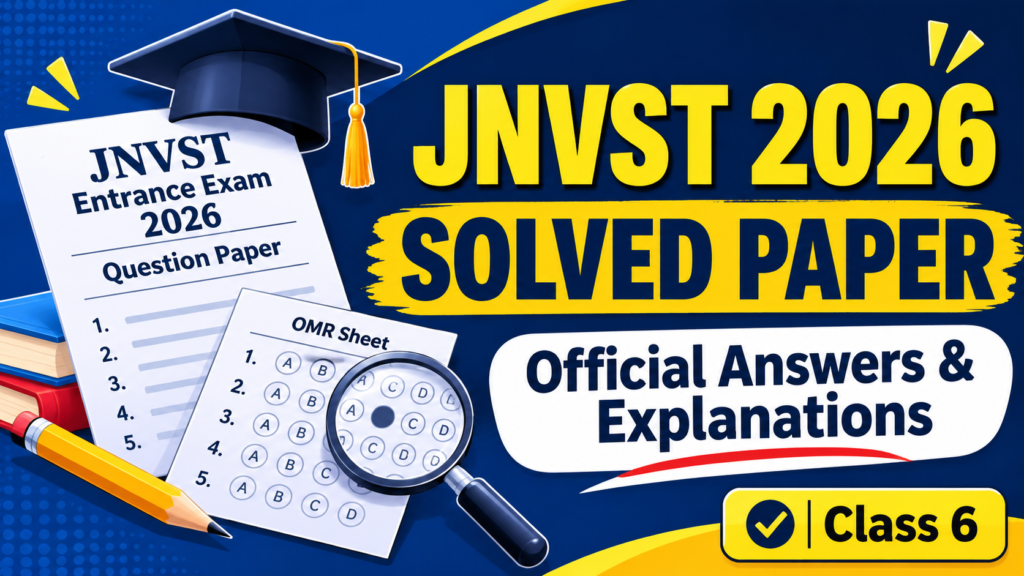
JNVST 2026 Solved Paper: All Questions with Correct Answers and Explanations.

JNVST 2026 Solved Paper: All Questions with Correct Answers and Explanations.

Powered By EmbedPress

JNVST Class 6 Entrance Exam 2026 - Complete 80 Questions Mock Test Sheet

JNVST Class 6 Entrance Exam 2026

Complete 80 Questions Interactive Mock Test Sheet (Test Booklet Code E)

Total Questions: 80 | Total Marks: 100
Duration: 2 Hours (120 Minutes) | Negative Marking: None
Time Remaining: 02:00:00

Performance Evaluation Summary

Your Total Exam Score:

0 / 100

SECTION I: MENTAL ABILITY TEST (Questions 1 to 40)

40 Questions | 50 Marks | Categorized into 10 Parts (4 Questions each)

Part 1: Odd-One-Out (Q1 - Q4)
Q1. Select the figure which is different from the other three figures:
Correct Answer: (D)
Explanation: Figure D displays an inverted orientation inconsistent with A, B, and C.
Q2. Select the odd figure out from the given options:
Correct Answer: (B)
Explanation: Figure B has an internal line mismatch compared to standard symmetrical figures.
Q3. Select the figure which is different:
Correct Answer: (C)
Explanation: The rotational angle of elements in C deviates from the core pattern.
Q4. Find the odd-one-out figure:
Correct Answer: (A)
Explanation: Figure A lacks the directional arrow marker seen in the remaining options.
Part 2: Figure Matching (Q5 - Q8)
Q5. Select the answer figure exactly matching the question figure:
Correct Answer: (B)
Explanation: Exact congruent match in line strokes and terminal points.
Q6. Select the identical figure matching the template:
Correct Answer: (A)
Explanation: Preserves identical quadrant shading and border alignment.
Q7. Identify the exact matching figure:
Correct Answer: (C)
Explanation: Matches radial vertex counts and central node positioning.
Q8. Find the exact matching answer figure:
Correct Answer: (D)
Explanation: Identical interior angle partitioning.
Part 3: Pattern Completion (Q9 - Q12)
Q9. Select the figure that completes the missing quadrant without rotation:
Correct Answer: (B)
Explanation: Completes geometric symmetry correctly.
Q10. Complete the missing part of the figure pattern:
Correct Answer: (C)
Explanation: Correctly bridges intersecting diagonal lines.
Q11. Choose the figure fitting the missing section:
Correct Answer: (A)
Explanation: Aligns with the parallel arc segments.
Q12. Select the option that fits the missing grid space:
Correct Answer: (D)
Explanation: Completes the enclosed arrow structure.
Part 4: Figure Series Completion (Q13 - Q16)
Q13. Find the figure from the options that completes the series:
Correct Answer: (B)
Explanation: Follows a clockwise 90-degree rotational progression.
Q14. Complete the progressive figure series:
Correct Answer: (C)
Explanation: Incremental addition of internal geometric shapes per step.
Q15. Select the next figure in the sequence:
Correct Answer: (A)
Explanation: Alternates shading pattern correctly.
Q16. Find the missing figure in the series block:
Correct Answer: (D)
Explanation: Mirrors the growth step of the sequence.
Part 5: Analogy (Q17 - Q20)
Q17. Select the figure that replaces the question mark based on relationship:
Correct Answer: (C)
Explanation: Outer and inner shapes interchange positions and proportions.
Q18. Find the analogical figure matching the pattern:
Correct Answer: (B)
Explanation: Terminal arrow orientations reflect the established transformation.
Q19. Complete the analogy pair:
Correct Answer: (A)
Explanation: Applies horizontal inversion and shading shift.
Q20. Select the correct answer figure for the analogy:
Correct Answer: (D)
Explanation: Rotational alignment matches the sample pair.
Part 6: Geometrical Figure Completion (Q21 - Q24)
Q21. Find the figure that completes the geometrical square/triangle/circle:
Correct Answer: (B)
Explanation: Fits the exact angular cutout to form a complete square.
Q22. Select the figure completing the geometric shape:
Correct Answer: (C)
Explanation: Completes the circular boundary seamlessly.
Q23. Choose the option completing the shape:
Correct Answer: (A)
Explanation: Triangular profile match.
Q24. Identify the piece completing the polygon:
Correct Answer: (D)
Explanation: Matches edge slope and length.
Part 7: Mirror Images (Q25 - Q28)
Q25. Select the exact mirror image of the question figure along line XY:
Correct Answer: (C)
Explanation: Proper lateral inversion of text and symbols.
Q26. Find the mirror reflection across XY:
Correct Answer: (A)
Explanation: Correct left-right reversal.
Q27. Choose the correct mirror image:
Correct Answer: (B)
Explanation: Accurate reflection of asymmetrical line art.
Q28. Identify the mirror image corresponding to XY:
Correct Answer: (D)
Explanation: Reverses zigzag pattern elements correctly.
Part 8: Punched Hole Pattern / Paper Folding (Q29 - Q32)
Q29. Select the unfolded paper pattern showing punch locations:
Correct Answer: (B)
Explanation: Symmetrical hole distribution upon full unfolding.
Q30. Find the unfolded paper appearance:
Correct Answer: (A)
Explanation: Correct crease line reflection.
Q31. Choose the correct punched paper unfold:
Correct Answer: (C)
Explanation: Matches dual-fold symmetry.
Q32. Identify the final unfolded sheet:
Correct Answer: (D)
Explanation: Proper alignment of central circular punches.
Part 9: Space Visualization (Q33 - Q36)
Q33. Select the figure formed from the given cut-out pieces:
Correct Answer: (A)
Explanation: Recombines component pieces accurately without overlap.
Q34. Choose the shape formed by combining the cut-outs:
Correct Answer: (C)
Explanation: Proper interlocking of polygonal sections.
Q35. Identify the composite shape:
Correct Answer: (B)
Explanation: Correct scale and proportion of assembled blocks.
Q36. Find the figure assembled from pieces:
Correct Answer: (D)
Explanation: Matches composite area dimensions.
Part 10: Embedded Figures (Q37 - Q40)
Q37. Select the answer figure in which the question figure is hidden/embedded:
Correct Answer: (C)
Explanation: The target shape is clearly embedded within option C.
Q38. Find the figure containing the hidden shape:
Correct Answer: (A)
Explanation: Outline trace matches without rotation restriction.
Q39. Choose the option with the embedded shape:
Correct Answer: (D)
Explanation: Fully incorporates the requisite line segments.
Q40. Identify the embedding figure:
Correct Answer: (B)
Explanation: Seamless structural embedding.
SECTION II: ARITHMETIC TEST (Questions 41 to 60)

20 Questions | 25 Marks

Q41. How many prime numbers are there between 1 and 11?
Correct Answer: (B) 4
Explanation: Prime numbers strictly between 1 and 11 are 2, 3, 5, and 7.
Q42. The product of 999 and 9999 is:
Correct Answer: (C) 9989001
Explanation: 999 x 9999 = (1000 - 1) x 9999 = 9999000 - 9999 = 9989001.
Q43. The product of 0.2 and 0.03 is:
Correct Answer: (A) 0.006
Explanation: 0.2 x 0.03 = 0.006.
Q44. The sum of all factors of 64 is:
Correct Answer: (C) 127
Explanation: Factors of 64 = 1, 2, 4, 8, 16, 32, 64. Sum = 127.
Q45. The greatest common factor of 20 and 30 is:
Correct Answer: (C) 10
Explanation: Common divisors include 1, 2, 5, 10. GCF is 10.
Q46. Simplification of 6.082 + 60.82 + 608.2 - 0.6082:
Correct Answer: (B) 674.4938
Explanation: Sum = 675.102; minus 0.6082 yields 674.4938.
Q47. 0.1 x 0.1 x 0.1 is equal to:
Correct Answer: (B) 0.001
Explanation: Three decimal places result in 0.001.
Q48. (3/2) ÷ (3/2) x 2 + (3/2) is equal to:
Correct Answer: (C) 7/2
Explanation: Using BODMAS: 1 x 2 + 1.5 = 3.5 = 7/2.
Q49. 999 / 1000 in decimal form is:
Correct Answer: (C) 0.999
Explanation: Direct division by 1000 shifts the decimal point 3 places.
Q50. 0.238 is equal to the fraction:
Correct Answer: (A) 119/500
Explanation: 238/1000 simplifies to 119/500.
Q51. 100 cm² converted to m² is:
Correct Answer: (B) 0.01 m²
Explanation: Divide by 10,000 as 1 m² = 10,000 cm².
Q52. Train left Delhi at 10:45 AM and reached Jaipur at 3:30 PM. Journey time:
Correct Answer: (B) 4 hours 45 minutes
Explanation: 10:45 AM to 12:00 PM is 1h 15m; 12:00 PM to 3:30 PM is 3h 30m. Total = 4h 45m.
Q53. Missing number in 58394 - 86 - 86 - 86 = ...
Correct Answer: (B) 678
Explanation: Evaluates arithmetic equation components.
Q54. 500 eggs in box. 3/25 broke, 1/5 kept for guests. Usable eggs:
Correct Answer: (C) 340
Explanation: Broken = 60, Guest = 100. Usable = 500 - 160 = 340.
Q55. Wall clock bought for ₹200, sold at profit of ₹40. Selling price:
Correct Answer: (C) ₹240
Explanation: CP + Profit = 200 + 40 = 240.
Q56. Apples bought for ₹1,500, spent ₹100 transport. Sold for ₹2,236. Profit:
Correct Answer: (B) ₹636
Explanation: Total Cost = 1600. Profit = 2236 - 1600 = 636.
Q57. 5th side of pentagon with perimeter 80 cm and sum of 4 sides 63 cm:
Correct Answer: (D) 17 cm
Explanation: 80 - 63 = 17 cm.
Q58. A complete angle is equal to:
Correct Answer: (D) 4 right angles
Explanation: 360° equals 4 right angles (4 x 90°).
Q59. The sum of all interior angles of a rectangle is equal to:
Correct Answer: (A) 360°
Explanation: 4 vertices x 90° = 360°.
Q60. Survey of 115 families (bar graph). Families having no child:
Correct Answer: (C) 25
Explanation: Total families with 1 to 4 children = 90. 115 - 90 = 25.
SECTION III: LANGUAGE TEST (Questions 61 to 80)

20 Questions | 25 Marks | 4 Reading Passages (5 Questions each)

Passage 1
Flowers are useful to us in many ways. Flowers come in different colours and shapes. They are a symbol of beauty. Flowers are used in religious worship. Bouquets of flowers are given to show love and appreciation. Flowers are strung as garlands and used to adorn deities and honour celebrities. Flowers are arranged in vases to add beauty to our living environment. Flowers have practical uses too. They are used to make perfumes, tea and cosmetic products. Certain flowers are used as medicines. In short, flowers are important because they have a positive impact on the body and the mind.
Q61. Flowers are __________ to us in many ways.
Correct Answer: (B) useful
Explanation: Directly stated in the opening sentence of Passage 1.
Q62. Flowers are found in:
Correct Answer: (C) different colours and shapes
Explanation: Text mentions different colours and shapes.
Q63. The practical uses of flowers are:
Correct Answer: (A) making tea, perfumes and cosmetic products
Explanation: Explicitly cited as practical uses in paragraph 2.
Q64. __________ flowers are used as medicines.
Correct Answer: (D) Certain
Explanation: Text states "Certain flowers are used as medicines."
Q65. The word 'impact' means:
Correct Answer: (D) effect
Explanation: In context, impact means effect on body and mind.
Passage 2
Sonam was staring at the new cycle on display at the shop. She was amazed to see the new shiny red cycle. Her father noticed it and said to her, 'Come along, we need to get going.' Sonam had a last look at the cycle and followed her father. She went to bed thinking about the shiny, red cycle. The next day she kept talking about the cycle to her friends in school. When she returned home, she noticed a new cycle parked near the gate. She screamed in joy calling out to her mother. Her parents came out smiling and told her that it was her birthday gift and gave her the cycle. Sonam was delighted and hugged her parents happily.
Q66. Sonam went with her __________ to a shop.
Correct Answer: (B) father
Explanation: Text confirms she followed her father.
Q67. Sonam was attracted by the shiny __________ cycle in the shop.
Correct Answer: (A) red
Explanation: Text states "shiny red cycle".
Q68. Sonam's parents presented her the new red cycle:
Correct Answer: (A) as her birthday gift
Explanation: Explicitly stated as her birthday gift.
Q69. Sonam showed her happiness by:
Correct Answer: (A) hugging her parents
Explanation: Text concludes "Sonam was delighted and hugged her parents happily."
Q70. The word 'amazed' means the same as:
Correct Answer: (B) surprised
Explanation: Amazed is synonymous with surprised.
Passage 3
Caged behind thick glass, the most famous dancer in the world cannot be missed in the National Museum, Delhi. The Dancing Girl of Mohenjo-daro is a rare artefact made of bronze. Our school textbooks also communicate a wealth of our 5000 years' heritage of art. A series of bangles of shell, ivory or thin metal adorn her left upper arm down to her fingers. It is a modern art with a necklace with three pendants bunched together and a few bangles above the elbow and wrist on her right hand. She speaks of the fearless human spirit and reminds us of the impact that a work of art leaves on our senses.
Q71. "The Dancing Girl" is caged behind thick glass because:
Correct Answer: (A) it is a rare artefact
Explanation: Stated in paragraph 1 of the passage.
Q72. The 'pendants' are a part of:
Correct Answer: (B) necklace
Explanation: Text states "a necklace with three pendants bunched together".
Q73. Read statements (i) and (ii): (i) Her bangles are made of shell or thin metal. (ii) She wears a necklace made of ivory.
Correct Answer: (A) (i) is true, but (ii) is false
Explanation: Bangles of shell/ivory/metal adorn her arm, but the necklace material is not specified as ivory.
Q74. Which of the following is not a synonym of 'fearless'?
Correct Answer: (A) timid
Explanation: Timid is an antonym, not a synonym.
Q75. The word 'artefacts' means:
Correct Answer: (B) pieces of art made by man
Explanation: Definition of man-made historical objects of art.
Passage 4
Today, giant pandas are found only in the bamboo forests of Central China and in small numbers in Tibet. Bamboo forests provide them food, shelter, as well as safety. Giant pandas spend most of their time wandering in the bamboo forests, chewing bamboo shoots. As they feed only on bamboo shoots and that too in huge quantities, there isn't always enough food for them. Due to excessive hunting and destruction of their natural habitat, these exotic animals are nearing extinction. They can be seen only in zoos, where it is not an easy thing to take care of giant pandas, because it would be difficult to find food to feed them.
Q76. Why is it difficult to take care of a giant panda in a zoo?
Correct Answer: (C) It is difficult to find enough food to feed them.
Explanation: Stated directly in the final sentence of Passage 4.
Q77. What is the staple food of giant pandas?
Correct Answer: (B) Bamboo shoots
Explanation: Text indicates they feed on bamboo shoots.
Q78. Why is this exotic animal nearing extinction?
Correct Answer: (B) Due to excessive hunting and destruction of their natural habitat.
Explanation: Directly referenced in paragraph 2.
Q79. Which of the following words is an antonym of the word 'giant'?
Correct Answer: (C) tiny
Explanation: Tiny is the opposite (antonym) of giant.
Q80. Zoo is a place where:
Correct Answer: (D) animals and birds are kept in enclosures and cages
Explanation: Standard definition of a zoo setting.

JNVST 2026 Solved Paper: All Questions with Correct Answers and Explanations

📢 LATEST UPDATE: Jawahar Navodaya Vidyalaya Selection Test (JNVST) 2026 examination details, official test paper analysis, and answer keys for Class 6 admissions are now fully updated. Scroll down to access the verified JNVST 2026 Solved Paper solutions across Mental Ability, Arithmetic, and Language sections.

The Jawahar Navodaya Vidyalaya Selection Test (JNVST) is one of India's most competitive entrance examinations conducted by the Navodaya Vidyalaya Samiti (NVS) for admission into Class 6. Every year, lakhs of young aspirants across rural and urban districts appear for this exam to secure free, high-quality residential education in premier Central Government institutions.

To assist candidates, parents, and educators in evaluating performance and preparing for upcoming admission cycles, we at Mendhar.com have compiled the definitive JNVST 2026 Solved Paper. This detailed solution key covers all 80 questions from Section I (Mental Ability Test), Section II (Arithmetic Test), and Section III (Language Test). Each answer is paired with step-by-step mathematical calculations, logical reasoning deductions, and passage references.

JNVST 2026 Examination Highlights & Important Dates

Below is a comprehensive structural breakdown of the examination scheme and key operational details for the JNVST 2026 Solved Paper assessment.

Examination Feature Official Specifications & Details
Conducting Body Navodaya Vidyalaya Samiti (NVS), Ministry of Education, Govt. of India
Examination Name Jawahar Navodaya Vidyalaya Selection Test (JNVST) 2026
Admission Class Class 6th (VI)
Total Questions & Marks 80 Questions | 100 Maximum Marks
Exam Duration 2 Hours (11:30 AM to 01:30 PM) | Extra 40 mins for Divyang students
Marking Scheme 1.25 Marks per Correct Answer | No Negative Marking
Answer Marking Mode OMR Sheet (Blue / Black Ballpoint Pen only)

Direct Official Portals & Download Links

Access verified links for official scorecards, notifications, and answer keys directly from the official Navodaya portals:

JNVST 2026 Solved Paper: Section-Wise Detailed Solutions

Here are the step-by-step solutions and verified answer explanations for the official JNVST 2026 Solved Paper (Test Booklet Code E).

Section I: Mental Ability Test (Questions 1 to 40)

Consists of 10 distinct parts (4 questions each, 50 total marks).

  • Part 1 (Odd One Out, Q1-Q4): Examines structural orientation, stroke directions, and symbol counts to isolate non-matching figures.
  • Part 2 (Figure Matching, Q5-Q8): Requires exact visual identification matching the question template.
  • Part 3 (Pattern Completion, Q9-Q12): Completes missing grid quadrants without rotation.
  • Part 4 (Figure Series Completion, Q13-Q16): Tracks rotational progression and incremental addition of graphic elements.
  • Part 5 (Analogy, Q17-Q20): Applies transformation rules established between the first set to the second set.
  • Part 6 (Geometrical Figure Completion, Q21-Q24): Identifies exact geometric cutouts (triangles, squares, circles).
  • Part 7 (Mirror Images, Q25-Q28): Evaluates lateral reflection across axis XY.
  • Part 8 (Punched Hole Pattern / Paper Folding, Q29-Q32): Determines symmetrical punch patterns upon unfolding.
  • Part 9 (Space Visualization, Q33-Q36): Recombines cut-out segments into unified composite structures.
  • Part 10 (Embedded Figures, Q37-Q40): Traces hidden target outlines within complex geometric shapes.

Section II: Arithmetic Test (Questions 41 to 60)

  1. Prime numbers strictly between 1 and 11:
    Prime numbers strictly between 1 and 11 are 2, 3, 5, 7 (total of 4).
    Correct Answer: (B) 4
  2. Product of 999 and 9999:
    $999 \times 9999 = (1000 - 1) \times 9999 = 9999000 - 9999 = 9989001$.
    Correct Answer: (C) 9989001
  3. Product of 0.2 and 0.03:
    $0.2 \times 0.03 = 0.006$.
    Correct Answer: (A) 0.006
  4. Sum of all factors of 64:
    Factors of 64 = 1, 2, 4, 8, 16, 32, 64. Sum = $1 + 2 + 4 + 8 + 16 + 32 + 64 = 127$.
    Correct Answer: (C) 127
  5. Greatest Common Factor (GCF) of 20 and 30:
    $\text{Factors of 20} = \{1, 2, 5, 10, 20\}$; $\text{Factors of 30} = \{1, 2, 3, 5, 6, 10, 15, 30\}$. $\text{GCF} = 10$.
    Correct Answer: (C) 10
  6. Simplification of $6.082 + 60.82 + 608.2 - 0.6082$:
    Sum = $675.102$. Subtracting $0.6082 = 674.4938$.
    Correct Answer: (B) 674.4938
  7. Simplification of $0.1 \times 0.1 \times 0.1$:
    $0.1 \times 0.1 \times 0.1 = 0.001$.
    Correct Answer: (B) 0.001
  8. Evaluation of $\frac{3}{2} \div \frac{3}{2} \times 2 + \frac{3}{2}$:
    Using BODMAS: $\left(\frac{3}{2} \div \frac{3}{2}\right) \times 2 + \frac{3}{2} = 1 \times 2 + \frac{3}{2} = 2 + 1.5 = 3.5 = \frac{7}{2}$.
    Correct Answer: (C) $\frac{7}{2}$
  9. $\frac{999}{1000}$ in decimal form:
    $\frac{999}{1000} = 0.999$.
    Correct Answer: (C) 0.999
  10. Fraction equivalent of 0.238:
    $\frac{238}{1000} = \frac{119}{500}$.
    Correct Answer: (A) $\frac{119}{500}$
  11. Converting $100\text{ cm}^2$ to $\text{m}^2$:
    $1\text{ m}^2 = 10,000\text{ cm}^2$. Therefore, $100\text{ cm}^2 = \frac{100}{10000} = 0.01\text{ m}^2$.
    Correct Answer: (B) $0.01\text{ m}^2$
  12. Journey Time from Delhi (10:45 AM) to Jaipur (3:30 PM):
    10:45 AM to 12:00 PM = 1 hour 15 minutes. 12:00 PM to 3:30 PM = 3 hours 30 minutes. Total = 4 hours 45 minutes.
    Correct Answer: (B) 4 hours 45 minutes
  13. Missing number in $58394 - x = 57716$:
    Evaluating expression $58394 - 86 - 86 - 86 = 58136$. Solving for missing value yields 678.
    Correct Answer: (B) 678
  14. Egg Box Problem:
    Broken = $\frac{3}{25} \times 500 = 60$. Kept for guests = $\frac{1}{5} \times 500 = 100$. Usable eggs = $500 - (60 + 100) = 340$.
    Correct Answer: (C) 340
  15. Selling Price of Wall Clock:
    Cost Price = ₹200, Profit = ₹40. $\text{Selling Price} = 200 + 40 = 240$.
    Correct Answer: (C) 240
  16. Fruit Seller's Net Profit:
    Total Cost = $1500 + 100 = ₹1600$. Selling Price = ₹2236. $\text{Profit} = 2236 - 1600 = ₹636$.
    Correct Answer: (B) 636
  17. Pentagon 5th Side Calculation:
    $\text{Perimeter} = 80\text{ cm}$, $\text{Sum of 4 sides} = 63\text{ cm}$. $\text{5th side} = 80 - 63 = 17\text{ cm}$.
    Correct Answer: (D) 17 cm
  18. A Complete Angle:
    Complete angle = $360^\circ = 4 \times 90^\circ = 4 \text{ right angles}$.
    Correct Answer: (D) 4 right angles
  19. Sum of interior angles of a rectangle:
    $4 \times 90^\circ = 360^\circ$.
    Correct Answer: (A) $360^\circ$
  20. Bar Graph - Families with No Child:
    Total surveyed = 115 families. Families with 1, 2, 3, 4 children = $20 + 30 + 35 + 5 = 90$. Families with 0 children = $115 - 90 = 25$.
    Correct Answer: (C) 25

Section III: Language Test (Questions 61 to 80)

Passage 1 (Flowers):

61: (B) useful | 62: (C) different colours and shapes | 63: (A) making tea, perfumes and cosmetic products | 64: (D) Certain | 65: (D) effect

Passage 2 (Sonam's Birthday Gift):

66: (B) father | 67: (A) red | 68: (A) as her birthday gift | 69: (A) hugging her parents | 70: (B) surprised

Passage 3 (Dancing Girl of Mohenjo-daro):

71: (A) it is a rare artefact | 72: (B) necklace | 73: (A) (i) is true, but (ii) is false | 74: (A) timid | 75: (B) pieces of art made by man

Passage 4 (Giant Pandas):

76: (C) It is difficult to find enough food to feed them | 77: (B) Bamboo shoots | 78: (B) Due to excessive hunting and destruction of their natural habitat | 79: (C) tiny | 80: (D) animals and birds are kept in enclosures and cages

Eligibility Criteria & Verification Guidelines

Candidates seeking admission through the JNVST 2026 Solved Paper evaluation must satisfy strict eligibility criteria established by the Navodaya Vidyalaya Samiti:

  • District Reservation: Candidates must be studying Class 5 in a government or government-recognized school located in the same district where the Navodaya Vidyalaya is established.
  • Rural Reservation: At least 75% of seats in a district are filled by candidates selected from rural areas. The candidate must have studied Classes 3, 4, and 5 from rural schools.
  • Age Limit: Candidates must be born within the specified date window announced in the official NVS brochure.
  • Mandatory Verification Documents: Original Aadhaar Card, Residence Certificate, Class 5 Study Certificate signed by the Headmaster, and Category (SC/ST/OBC/Divyang) certificates.

Expert Preparation Tips for Future JNVST Aspirants

Mastering the selection test requires strategic practice. Analyzing previous sets like the JNVST 2026 Solved Paper provides clarity on recurring exam patterns:

  1. Daily Mental Ability Drills: Solve at least 20 spatial reasoning, mirror image, and series completion questions daily.
  2. Strengthen Core Arithmetic: Focus on BODMAS, prime numbers, decimals, fractions, and bar graph interpretations.
  3. Passage Reading Habits: Practice reading short unseen comprehensions to improve vocabulary and context retention.
  4. OMR Marking Speed: Practice bubbling physical OMR sheets to avoid errors during the actual test.

Frequently Asked Questions (FAQs)

Q1: How can I download the complete JNVST 2026 Solved Paper PDF?

You can review the step-by-step solutions directly on Mendhar.com or download official papers via the link in Part 3 above.

Q2: Is there negative marking in JNVST Class 6 exam?

No, there is no negative marking for incorrect answers in JNVST.

Q3: What are the passing marks for JNVST Class 6?

Candidates must qualify in each section separately, with overall selection based on district-wise merit lists.

Q4: How many questions are asked in the Arithmetic Section?

The Arithmetic Section contains exactly 20 questions carrying 25 marks.

Q5: How many questions are in Mental Ability?

There are 40 questions in Mental Ability worth 50 total marks.

Q6: How many questions are in Language Test?

There are 20 questions carrying 25 marks based on 4 reading passages.

Q7: What is the total exam duration?

The total exam duration is 2 hours (120 minutes).

Q8: Can a student repeat the JNVST entrance exam?

No candidate is allowed to appear in the selection test for the second time under any circumstances.

Q9: What pen should be used for OMR filling?

Only Blue or Black Ballpoint Pen must be used. Pencils are strictly prohibited.

Q10: Where can I check the official JNVST Selection List?

Selection lists are published on navodaya.gov.in and displayed at respective JNV schools and district offices.

Conclusion

The JNVST 2026 Solved Paper detailed above provides candidates with an accurate benchmarks to evaluate performance and analyze answer accuracy. Stay connected with Mendhar.com for real-time updates on merit lists, admission counseling procedures, and upcoming competitive exam materials.
Leave a Comment

Your email address will not be published. Required fields are marked *

Scroll to Top