Get complete NCERT Solutions for Class 9 History Chapter 1 – The French Revolution in simple language. Includes all questions with answers, exam-ready explanations, and FAQs.
Understanding The French Revolution is very important for Class 9 students because it explains how modern democracy, equality, and rights developed. This chapter is not only useful for exams but also helps students understand how societies change over time.
In this blog, you will find all important NCERT questions with simple answers, written in easy language so that every student can understand and revise quickly before exams.
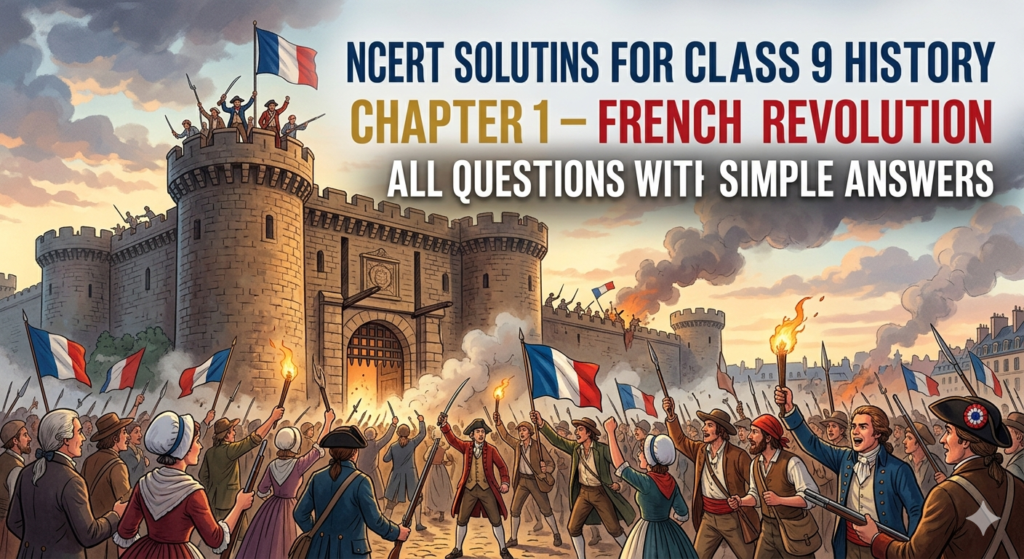
Table of Contents
Toggle📥 Download Notes PDF
📘 NCERT Questions with Answers (S.No. Wise)
1. Describe the circumstances leading to the outbreak of revolutionary protest in France.
Answer:
Before the revolution, France was facing serious problems. The king, Louis XVI, had spent a lot of money on wars and royal luxuries, which emptied the treasury. The government had taken loans and had to pay high interest.
The society was divided into three estates, and only the Third Estate (common people) paid taxes. The rich classes were free from taxes. At the same time, population increased, but food production did not. This caused a rise in bread prices.
Poor people suffered the most because their wages were low. Due to all these reasons—economic crisis, inequality, and hunger—people became angry and started protesting, which led to the revolution.
2. Which groups of French society benefited from the revolution? Which groups were forced to relinquish power? Which sections of the society would have been disappointed with the outcome of the revolution?
Answer:
The Third Estate, which included peasants, workers, and middle-class people, benefited the most. They got more rights and equality.
The First Estate (clergy) and Second Estate (nobility) lost their privileges and power.
However, women and some poor sections were disappointed because they were not given equal rights or political power.
3. Draw up a list of democratic rights we enjoy today whose origin could be traced to the French Revolution.
Answer:
- Freedom of speech
- Freedom of expression
- Freedom of press
- Right to vote
- Right to liberty
- Right to equality
- Right to education
- Abolition of slavery
- Right to property
- Right to security
4. Would you agree with the view that the message of universal rights was beset with contradictions? Explain.
Answer:
Yes, the idea of universal rights had contradictions. Although equality was promised, women were not given equal rights.
They could not vote or participate in government. So, the revolution did not truly provide equal rights to everyone.
5. How would you explain the rise of Napoleon?
Answer:
Napoleon Bonaparte was a powerful military leader. After the revolution, he gained control and declared himself Emperor of France.
He introduced reforms like equal laws and protection of property. He also spread revolutionary ideas to other countries. Later, he was defeated in the Battle of Waterloo.
6. What made France a Constitutional Monarchy?
Answer:
In 1791, a constitution was introduced in France. It limited the powers of the king.
The law-making power was given to elected representatives. This system is called a Constitutional Monarchy.
7. Why did the Jacobins change their pattern of dress?
Answer:
The Jacobins wore simple clothes to show equality. They rejected expensive clothes worn by nobles.
They wore long trousers instead of knee-length breeches to show their support for common people.
8. France became a republic on 21st September 1792. How did it affect the monarchy?
Answer:
When France became a republic, the monarchy was abolished.
King Louis XVI was removed from power and later executed. The country was then ruled by elected representatives.
9. Describe the impact of the French Revolution on the people of the world.
Answer:
The French Revolution spread ideas of liberty, equality, and democracy across the world.
It inspired people in other countries to fight against injustice and demand rights. It also helped in ending feudal systems and encouraged independence movements.
Forced to give up power: The king, nobles, and clergy.
Disappointed: Poor workers, landless peasants, and women, because they still faced poverty and did not get voting rights.
- Right to vote
- Freedom of speech and press
- Equality before law
- Right to own property
- No arrest without trial (due process)