The Indian education system has undergone a significant shift with the introduction of the Right of Children to Free and Compulsory Education (Amendment) Bill, 2026. This amendment has brought much-needed clarity and relief to lakhs of teachers across the country who were worried about the mandatory requirement of the Teacher Eligibility Test.
In this detailed blog, we will fully explain the topic “TET Not Mandatory for Existing Teachers – New Bill Explained”, covering its background, legal implications, impact, and what it means for both current and future educators.
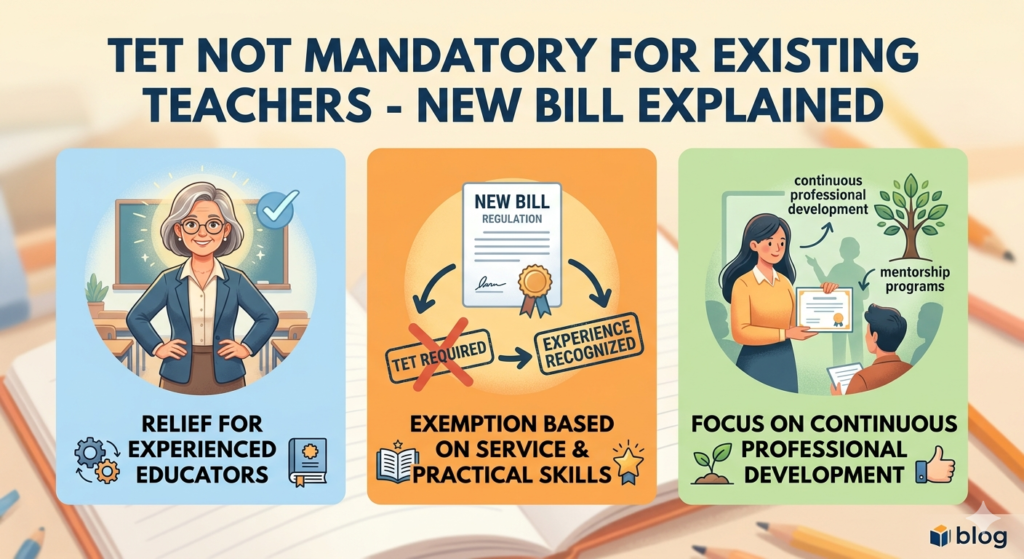
Table of Contents
ToggleIntroduction to the Issue
For years, the Right of Children to Free and Compulsory Education Act, 2009 has governed elementary education in India. Under this law, minimum qualifications for teachers were introduced to ensure quality education.
One of the key requirements that emerged over time was the Teacher Eligibility Test (TET). It became a benchmark for selecting qualified teachers.
However, a major controversy arose when courts began interpreting that TET should also apply to teachers who were already working before the law came into effect. This created confusion, stress, and fear among experienced teachers.
This is exactly where “TET Not Mandatory for Existing Teachers – New Bill Explained” becomes crucial.
Background: How the Problem Started
The issue intensified after a Supreme Court judgment in 2025. The court ruled that:
TET is a minimum qualification
Even teachers already in service must qualify TET within a deadline
Failure to do so could lead to:
Job loss
Denial of promotion
Compulsory retirement
This decision caused widespread panic, especially among:
Rural teachers
Older teachers
Teachers nearing retirement
Many had been serving for decades without TET because it did not exist when they were appointed.
This situation made it necessary for the government to intervene, leading to the amendment that defines “TET Not Mandatory for Existing Teachers – New Bill Explained.”
What the New Bill Says
The amendment introduces several important changes to Section 23 of the RTE Act. The core idea is simple but powerful:
👉 TET will apply only prospectively (in the future)
👉 Existing teachers will be protected
This means:
Teachers already working before the amendment:
Do not need to pass TET
New teachers:
Must qualify TET
This central idea forms the backbone of “TET Not Mandatory for Existing Teachers – New Bill Explained.”
Key Provisions of the Amendment
Let’s understand the most important features of this bill in detail.
✅ 1. No Additional Qualification Required for Existing Teachers
The amendment clearly states that:
Teachers appointed before the amendment
Under valid recruitment rules
👉 Will not be required to acquire any new qualifications
This directly confirms “TET Not Mandatory for Existing Teachers – New Bill Explained.”
✅ 2. Protection of Service Conditions
The bill ensures that existing teachers:
Will continue their jobs without interruption
Will not face:
Termination
Forced retirement
Demotion
This is a major relief for thousands of educators.
✅ 3. No Penalty for Not Passing TET
Even if a teacher has not passed TET:
No punishment will be given
No salary reduction
No loss of benefits
This ensures dignity and fairness in the profession.
✅ 4. TET Mandatory Only for New Appointments
For future teachers:
TET remains compulsory
It will be a pre-condition for recruitment
Thus, the system maintains quality while protecting existing staff—perfectly summarizing “TET Not Mandatory for Existing Teachers – New Bill Explained.”
✅ 5. No Impact on Promotions or Retirement Benefits
The amendment clearly states:
Promotions cannot be denied due to lack of TET
Retirement benefits will remain unchanged
This is crucial for long-serving teachers.
Understanding “Prospective Application”
One of the most important legal concepts used in the amendment is prospective application.
What does it mean?
👉 Laws will apply only from now onward, not to past situations.
In simple terms:
New rules = For new teachers
Old teachers = Follow old rules
This principle is the legal foundation of “TET Not Mandatory for Existing Teachers – New Bill Explained.”
Why This Amendment is Important
This amendment is not just a policy change—it reflects fairness and justice.
✔ Protects Experienced Teachers
Teachers who have:
10–30 years of experience
Contributed to education in rural areas
Are now safe from sudden rule changes.
✔ Maintains Education Quality
By keeping TET mandatory for new teachers:
Standards remain high
Future teachers are well-qualified
✔ Prevents System Disruption
If thousands of teachers were removed:
Schools would suffer
Students would be affected
The amendment avoids this crisis.
Real-Life Impact
Let’s take a practical example:
Example:
A teacher joined in 2000:
Has 25 years of experience
Never appeared for TET
👉 Earlier situation:
Risk of losing job
Pressure to clear TET
👉 After amendment:
Job is safe
No need for TET
This clearly shows the importance of “TET Not Mandatory for Existing Teachers – New Bill Explained.”
Impact on Different Stakeholders
👨🏫 Existing Teachers
Relief from stress
Job security guaranteed
No exam pressure
👩🎓 New Teachers
Must prepare for TET
Higher competition
Better quality standards
🏫 Schools
Stability in teaching staff
No sudden vacancies
👨👩👧 Students
Continuity in education
Experienced teachers remain
Professional Development Still Encouraged
Even though TET is not mandatory for existing teachers:
Training programs will continue
Skill development will be encouraged
But importantly: 👉 These will NOT affect job security
Government’s Balanced Approach
The government has tried to strike a balance:
Aspect
Approach
Quality
TET for new teachers
Fairness
Protection for existing teachers
Stability
No disruption in schools
This balanced policy is at the heart of “TET Not Mandatory for Existing Teachers – New Bill Explained.”
Frequently Asked Questions (FAQs)
1. Is TET mandatory for existing teachers?
No. Under the Right of Children to Free and Compulsory Education (Amendment) Bill, 2026, TET is not mandatory for teachers already in service. This is the key point of “TET Not Mandatory for Existing Teachers – New Bill Explained.”
2. Who must qualify TET now?
Only new teachers appointed after the amendment must qualify the Teacher Eligibility Test.
3. Can existing teachers lose their job for not passing TET?
No. Existing teachers:
Cannot be removed
Cannot be forced to retire
Cannot face any penalty due to not passing TET
4. Will promotions be affected if a teacher has not cleared TET?
No. Promotions, salary, and other service benefits of existing teachers are fully protected.
5. Does this rule apply across all states in India?
Yes. Since it is part of the Right of Children to Free and Compulsory Education Act, 2009, it applies nationwide, though implementation may vary slightly by state.
6. What does “prospective application” mean in this context?
It means the TET requirement will apply only to future appointments, not to teachers already working.
7. Are existing teachers required to take any training?
Yes, they may undergo training or skill development, but:
It is not linked to job security
It is not compulsory like TET
8. Why was this amendment introduced?
It was introduced to:
Protect experienced teachers
Prevent unfair job loss
Clarify confusion created by court rulings
9. Is TET completely removed from the education system?
No. TET is still mandatory for new teachers to ensure quality education standards.
10. What is the main takeaway from this new bill?
👉 Existing teachers are safe without TET, while new teachers must qualify it.
This is the core message of “TET Not Mandatory for Existing Teachers – New Bill Explained.”
Final Thoughts
The amendment is a landmark step in India’s education policy. It ensures that:
Experienced teachers are respected
Sudden rule changes do not harm careers
Future recruitment remains strong
The confusion and fear surrounding TET requirements have finally been addressed.
Final Conclusion
The Right of Children to Free and Compulsory Education (Amendment) Bill, 2026 clearly establishes that:
👉 TET is NOT mandatory for existing teachers
👉 TET is compulsory only for new appointments
This makes the concept of “TET Not Mandatory for Existing Teachers – New Bill Explained” not just a headline, but a reality that protects thousands of teachers across India.