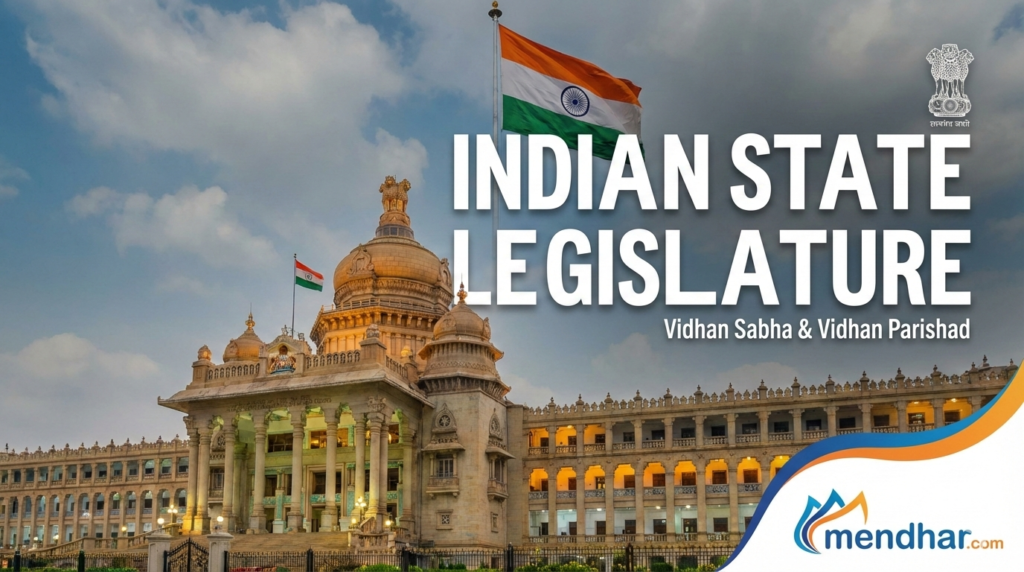
The State Legislature is an important pillar of the democratic system in India. It plays a vital role in making laws for the state, controlling the executive, and representing the will of the people. Just like the Union Parliament works at the national level, the State Legislature functions at the state level. Understanding the Indian State Legislature is essential for students of Political Science, competitive exams, and informed citizens.
Table of Contents
ToggleWhat is State Legislature?
The State Legislature is the law-making body of a state in India. It is responsible for enacting laws on subjects mentioned in the State List and Concurrent List of the Indian Constitution.
State Government Structure
Diagram of the legislative branches in Indian state governments
About the Structure
In Indian states with a bicameral legislature, the Governor is the constitutional head, while the Legislative Assembly (Vidhan Sabha) and Legislative Council (Vidhan Parishad) form the two houses of the state legislature.
Legislative Assembly
Members are directly elected by the public for 5-year terms. This is the more powerful house, responsible for most law-making and financial matters.
Legislative Council
Members are elected by various groups (graduates, teachers, MLAs, etc.) or nominated by the Governor. It acts as a revising chamber with limited powers.
Not all states have a Legislative Council. Therefore, State Legislatures in India can be unicameral or bicameral.
Types of State Legislature in India
1. Unicameral Legislature
A unicameral legislature has only one house:
Legislative Assembly (Vidhan Sabha)
Most Indian states follow this system.
2. Bicameral Legislature
A bicameral legislature has two houses:
Legislative Assembly (Vidhan Sabha)
Legislative Council (Vidhan Parishad)
States like Uttar Pradesh, Bihar, Maharashtra, Karnataka, Andhra Pradesh, and Telangana have bicameral legislatures.
Types of State Legislatures in India
Visual representation of unicameral and bicameral legislative structures in Indian states
1. Unicameral Legislature
A unicameral legislature has only one house. Most Indian states follow this system.
Unicameral States (Examples)
2. Bicameral Legislature
A bicameral legislature has two houses.
Bicameral States
These 6 states currently have bicameral legislatures in India.
Comparison of Legislature Types
| Feature | Unicameral Legislature | Bicameral Legislature |
|---|---|---|
| Number of Houses | One house (Legislative Assembly) | Two houses (Legislative Assembly + Legislative Council) |
| Prevalence in India | Majority of states (28 out of 34 states/UTs with legislatures) | Only 6 states |
| Decision Making | Faster, as only one house needs to approve legislation | Slower, requires approval from both houses |
| Check & Balance | Limited internal checks within the legislature | Built-in check between two houses |
| Composition | Directly elected members only | Mix of directly elected and indirectly elected/nominated members |
Note: The structure of state legislatures is defined by the Constitution of India. States can create or abolish their Legislative Council by a special majority in their Assembly and an Act of Parliament.
Composition of State Legislature
1. Governor
The Governor is an integral part of the State Legislature.
Appointed by the President of India
Acts as the constitutional head of the state
Gives assent to bills passed by the legislature
2. Legislative Assembly (Vidhan Sabha)
The Legislative Assembly is the lower house and the most powerful organ of the State Legislature.
Key Features:
Members are directly elected by the people
Term: 5 years (can be dissolved earlier)
Minimum age of member: 25 years
Chief Minister is a member of this House.
Composition of Vidhan Sabha
How the Legislative Assembly is formed through democratic elections
Key Features of MLA Elections
Note: The Vidhan Sabha is the lower house (or only house in unicameral states) of the state legislature in India. Its composition directly reflects the will of the people through democratic elections.
3. Legislative Council (Vidhan Parishad)
The Legislative Council is the upper house in bicameral states.
Key Features:
Permanent house (not dissolved)
One-third members retire every two years
Minimum age of member: 30 years
Composition of Vidhan Parishad:
1/3 elected by MLAs
1/3 elected by local bodies
1/12 elected by teachers
1/12 elected by graduates
1/6 nominated by the Governor
Powers and Functions of State Legislature
1. Legislative Powers
The State Legislature makes laws on subjects such as:
Police
Public health
Agriculture
Local government
Laws are made following a constitutional procedure and require the Governor’s assent.
2. Financial Powers
State budget is presented in the Legislative Assembly
Money Bills can be introduced only in the Vidhan Sabha
No tax can be levied without legislative approval
3. Executive Control
The State Legislature controls the executive through:
Question Hour
No-confidence motion
Debates and discussions
The Council of Ministers is collectively responsible to the Legislative Assembly.
4. Electoral Functions
The State Legislature:
Participates in the election of the President of India
Elects members to the Rajya Sabha
Law-Making Process in the State Legislature
How a Bill Becomes Law
The step-by-step process of transforming a legislative proposal into enforceable law
Key Information About the Legislative Process
Time Required
The process can take weeks to months depending on the complexity of the bill and legislative priorities. Ordinary bills typically take 1-3 months.
Bicameral Process
In states with two houses, the bill must pass through both houses. If there's disagreement, a joint sitting may be convened to resolve differences.
Governor's Options
The Governor can return the bill once for reconsideration. If passed again, the Governor must give assent. Certain bills require President's assent.
Types of Bills
Ordinary bills, money bills (only in Assembly), and constitutional amendment bills. Each follows slightly different procedures.
Legislative Timeline
The entire process from bill introduction to law enforcement demonstrates the careful deliberation and democratic principles embedded in India's legislative system. Each step ensures thorough scrutiny before a proposal becomes binding law.
Note: This diagram illustrates the standard legislative process. Certain bills (like Money Bills) follow special procedures as per constitutional provisions.
Explanation:
A bill is introduced in the Legislative Assembly.
It is discussed and examined.
After approval, it is sent to the Governor.
On receiving assent, the bill becomes law.
Role of State Legislature in Democracy
The Indian State Legislature strengthens democracy by:
Representing regional aspirations
Ensuring accountability of the government
Protecting people’s rights at the state level
Maintaining balance between Centre and States
Difference Between Unicameral and Bicameral State Legislature
Feature | Unicameral | Bicameral |
|---|---|---|
| Number of Houses | One | Two |
| Law-making speed | Faster | Slower |
| States | Majority | Few |
| Review mechanism | Limited | Better scrutiny |
Conclusion
The State Legislature in India plays a crucial role in governance and democracy. It ensures law-making, financial control, and executive accountability at the state level. Whether unicameral or bicameral, the State Legislature reflects the federal spirit of the Indian Constitution. A clear understanding of its structure, powers, and functions helps students and citizens appreciate how democracy works at the grassroots level.
Mendhar.com
Your Gateway to Authentic Educational Resources & Competitive Exam Preparation
Our Mission & Vision
Mendhar.com is an informative and student-friendly educational website dedicated to sharing authentic, easy-to-understand content related to competitive exams like JNVST, school education, government updates, and useful online services.
The website focuses on clear explanations, exam-oriented notes, step-by-step guides, and trusted information to help students, teachers, and the general public.
What Makes Us Special
Student-Centric Approach
Content designed specifically for competitive exam aspirants with focus on clarity and comprehension.
Authentic Information
All content is verified and updated regularly to ensure accuracy and reliability.
Teacher-Friendly Resources
Valuable resources for educators to enhance teaching methodologies and classroom engagement.
Accessibility Focus
Designed to be accessible to learners from rural and remote areas with limited resources.
Who We Serve
Students
Competitive exam aspirants & school students
Teachers
Educators seeking quality teaching resources
Rural Learners
Students from remote areas with limited access