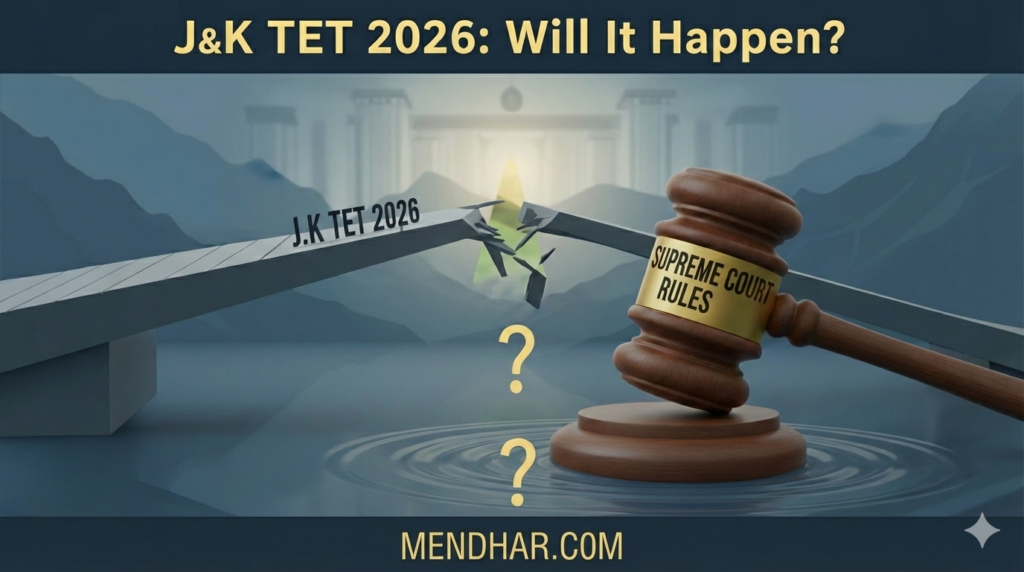
The Teacher Eligibility Test (TET) has become one of the most discussed education reforms across India. After a major ruling by the Supreme Court of India, all states and Union Territories were directed to ensure that teachers qualify TET for appointment and continuation of service.
Now the biggest question is — What is the current status of TET in Jammu & Kashmir?
In this detailed blog, we will explain the latest developments regarding TET with special reference to the Government of Jammu and Kashmir, including government statements, administrative steps, teachers’ reactions, and what this means for aspiring as well as in-service teachers.
Table of Contents
ToggleWhat is TET and Why Is It Important?
The Teacher Eligibility Test (TET) is a minimum qualification examination for candidates who wish to become teachers in government schools from Classes I to VIII.
It ensures:
Minimum teaching standards
Quality classroom education
Uniform eligibility criteria across states
Professional accountability
Under the Right to Education (RTE) Act framework, passing TET became mandatory in most states years ago. However, the situation in Jammu & Kashmir has evolved differently due to administrative and structural changes after becoming a Union Territory.
⚖ Supreme Court Direction: What Changed Nationally?
In 2025, the Supreme Court of India ruled that:
TET qualification is mandatory for government school teachers.
In-service teachers must also clear TET.
States must comply strictly with national teacher eligibility norms.
This ruling created nationwide discussions, especially in regions where TET was not strictly enforced earlier.
In-Depth Analysis: Supreme Court Order on TET & J&K Government’s Response
The debate over J&K TET 2026 cannot be understood properly without carefully examining two key elements:
The ruling of the Supreme Court of India
The official response of the Government of Jammu and Kashmir
Let us break both of these down in detail.
What Exactly Did the Supreme Court Say About TET?
The Supreme Court ruling in 2025 was not a routine observation — it was a strong and structured interpretation of teacher eligibility norms under national education laws.
🔹 Core Principle of the Judgment
The Court emphasized that:
Teacher quality directly impacts the fundamental right to education.
The Right to Education (RTE) framework mandates minimum qualifications.
TET is not optional — it is a mandatory professional benchmark.
The judgment reinforced that states cannot dilute national standards in teacher recruitment.
🏛 Latest Stand of the Government of Jammu & Kashmir (2026 Update)
As of early 2026, the Government of Jammu and Kashmir has clarified that:
No fresh government order has been issued making TET immediately mandatory.
The administration is reviewing implementation models followed by other states.
A final decision will be taken after proper evaluation.
Education Minister Sakina Itoo publicly stated that there is currently no official order enforcing compulsory TET in J&K.
This announcement provided temporary relief to many in-service teachers who were concerned about job security.
How Did the Government of Jammu & Kashmir Respond?
Following the Supreme Court order, there was immediate concern among teachers in J&K.
The Government of Jammu and Kashmir adopted a measured and cautious approach rather than rushing into enforcement.
📢 Official Clarification by the Education Minister
Education Minister Sakina Itoo clarified publicly that:
No immediate enforcement order has been issued.
The matter is under review.
The government is studying implementation patterns of other states.
This statement was crucial in calming widespread anxiety among serving teachers.
🏢 Administrative Steps Taken
Even though enforcement has not started, preparatory steps were taken.
The government designated:
Jammu and Kashmir Board of School Education (JKBOSE)
State School Standards Authority (SSSA)
as nodal agencies for TET.
This shows that the government is not ignoring the Supreme Court order — rather, it is preparing institutional mechanisms before implementation.
Key Highlights of the Supreme Court Order
1️⃣ TET is Mandatory for Appointment
The Court clearly stated that no teacher should be appointed in government schools without qualifying TET. This includes:
Primary teachers (Classes I–V)
Upper primary teachers (Classes VI–VIII)
The ruling effectively invalidates recruitment processes that ignore TET eligibility.
2️⃣ In-Service Teachers Must Also Qualify
One of the most debated aspects of the ruling was that:
Even existing teachers who were appointed without TET must qualify it within a reasonable period.
This created concern across several states, including Jammu & Kashmir, where many teachers were appointed under earlier rules.
3️⃣ No State Can Create Exceptions
The Court clarified that:
States and Union Territories must comply uniformly.
Administrative convenience cannot override national standards.
Teacher eligibility is a constitutional matter tied to students’ rights.
This means compliance is not discretionary.
4️⃣ Objective of the Order
The Court’s intention was not punitive but reformative:
To improve education standards.
To ensure competency in pedagogy.
To align all states with uniform teacher qualification norms.
The order reflects a nationwide move toward professionalization of school education.
🔎 Why Didn’t J&K Immediately Enforce the Order?
There are several practical reasons:
1️⃣ Large Number of In-Service Teachers
Thousands of teachers in J&K were appointed under earlier recruitment rules that did not require TET.
Immediate enforcement could:
Create job insecurity.
Trigger legal challenges.
Disrupt school functioning.
2️⃣ Transitional Policy Concerns
Implementing TET retroactively requires:
Clear guidelines
Grace periods
Training support
Exam infrastructure
The administration likely wants to avoid policy chaos.
3️⃣ Socio-Political Sensitivity
Education policy in Jammu & Kashmir carries additional administrative complexity due to:
Post-reorganization reforms
Alignment with central laws
Employment stability considerations
The government appears to be balancing compliance with stability.
Nodal Agencies Appointed in J&K
Although no enforcement order has been issued, the government has taken preparatory steps.
The following bodies have been designated as nodal agencies:
Jammu and Kashmir Board of School Education (JKBOSE)
State School Standards Authority (SSSA)
Their responsibilities may include:
Conducting TET examinations
Setting syllabus and exam pattern
Ensuring compliance with national teacher standards
Monitoring implementation
This clearly indicates that while TET is not enforced yet, groundwork is being prepared.
What Does This Mean for In-Service Teachers?
Currently:
No immediate requirement to pass TET.
No termination orders linked to TET qualification.
No promotion restrictions officially imposed.
However, if future orders are issued in compliance with the Supreme Court direction, in-service teachers may eventually be required to qualify TET.
Teacher associations have raised concerns about retroactive application of the rule.
The Jammu and Kashmir Teachers Forum has opposed making TET mandatory for already serving teachers, arguing that:
Many teachers have decades of service.
Sudden enforcement may create job insecurity.
Adequate transition time should be provided.
What About New Teacher Aspirants?
For candidates preparing for future recruitment in J&K:
TET may become mandatory before appointment.
Recruitment rules could align with national standards.
Competitive advantage may go to TET-qualified candidates.
Even though enforcement is pending, serious aspirants should consider preparing for TET in advance to stay ahead.
Frequently Asked Questions (FAQs)
Q1. Is TET compulsory in Jammu & Kashmir in 2026?

No. As of now, no official order has made TET compulsory in J&K.

Q2. Has the Supreme Court made TET mandatory?

Yes. The Supreme Court of India ruled that TET qualification is mandatory nationally.

Q3. Will in-service teachers lose jobs if they don’t clear TET?

Currently, there is no such order in J&K. Future policy decisions are awaited.

Q4. Which agency will conduct TET in J&K?

JKBOSE and SSSA have been designated as nodal agencies.

Q5. Should new teacher aspirants prepare for TET?

Yes. Since national policy favors mandatory TET, preparing in advance is advisable.

Q6. Will there be age relaxation or grace period?

No official notification has clarified this yet.

Q7. Is CTET valid in J&K?

CTET may be considered depending on future recruitment rules, but no final clarification has been issued.

Q8. When will J&K officially announce TET implementation?

The government has not announced a fixed timeline.
Final Conclusion
The TET issue in Jammu & Kashmir is at a transitional stage. While the Supreme Court ruling has created a national framework mandating teacher eligibility testing, the Government of Jammu and Kashmir has not yet enforced it locally.
However, the appointment of nodal agencies clearly signals that policy alignment may happen in the near future.
For teachers and aspirants, the safest strategy is preparation — because when official notification arrives, there may be limited time to act.
Stay informed, stay prepared, and keep monitoring official education department updates for the latest announcements.