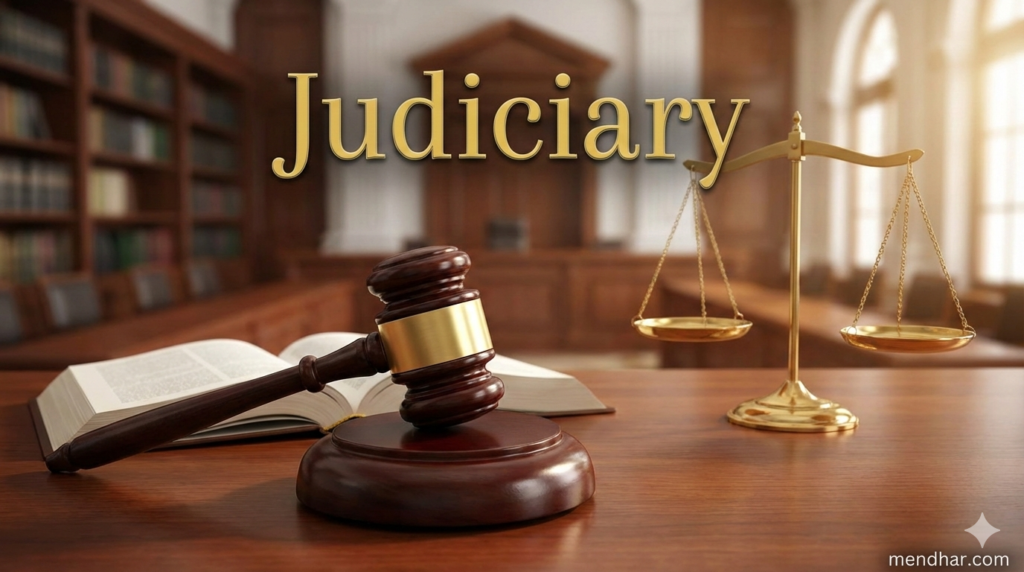
The system that interprets laws and ensures justice is a vital pillar of any democratic nation. In India, this institution safeguards the Constitution, protects fundamental rights, and acts as a check on the powers of the legislature and executive. The Judiciary plays a decisive role in maintaining the rule of law, resolving disputes, and ensuring that governance functions within constitutional limits.
This blog explains the meaning, structure, functions, independence, and importance of the Indian judicial system in a simple and student-friendly manner, while also addressing common questions at the end.
Table of Contents
ToggleMeaning and Concept
The term Judiciary refers to the branch of government responsible for interpreting laws, delivering justice, and resolving disputes according to legal principles. It applies laws enacted by the legislature and ensures their proper enforcement. Courts examine whether actions taken by the government or individuals are lawful and constitutional.
In a democracy, this system acts as the guardian of citizens’ rights and liberties. Without an effective mechanism for justice, laws would have little value and constitutional promises would remain merely theoretical.
Evolution of the Indian Judicial System
India's Legal System: From Colonial Roots to Constitutional Democracy
British Colonial Legacy
- Common law system with precedent-based jurisprudence
- Hierarchical court structure (lower courts, high courts, supreme court)
- Adversarial legal procedures and evidence rules
- Legal professions organized as barristers and solicitors
- Substantive laws like Indian Penal Code, Contract Act, Evidence Act
Post-Independence Transformation
- Constitution adopted on January 26, 1950
- Supremacy of the Constitution established
- Fundamental Rights guaranteed to all citizens
- Directive Principles for social and economic democracy
- Independent judiciary as a basic structure
Constitutional Foundation
Supreme Court
Guardian of the Constitution with original, appellate, and advisory jurisdictions. Final interpreter of constitutional provisions.
High Courts
Highest judicial authority in states with supervisory jurisdiction over all subordinate courts within their territory.
Subordinate Judiciary
District courts and lower courts that handle the majority of civil and criminal cases at grassroots level.
Judicial Evolution & Vision
Expanding Rights
Through Public Interest Litigation (PIL) and progressive interpretation, courts have expanded fundamental rights to include privacy, clean environment, and dignity.
Strengthening Accountability
Judicial activism has enforced transparency and accountability in governance through landmark judgments on corruption, environment, and public welfare.
Adapting to Change
Courts have interpreted laws in light of contemporary social realities, addressing issues like gender equality, LGBTQ+ rights, and digital privacy.
India's legal system represents a unique synthesis of colonial inheritance and indigenous innovation—a framework that has evolved from administering colonial law to becoming the guardian of the world's largest democracy, protecting constitutional values while adapting to contemporary challenges.
Structure of Courts in India
Hierarchical Structure of Indian Court System
Supreme Court of India
- Final interpreter of the Constitution
- Hears disputes between states and between Union and states
- Adjudicates cases involving fundamental rights
- Advisory jurisdiction on matters referred by President
- Power of judicial review over legislative and executive actions
High Courts
- Supervisory authority over all subordinate courts in the state
- Power to issue writs for enforcement of fundamental rights
- Original and appellate jurisdiction in civil and criminal matters
- Administrative control over district and sessions courts
- Can hear cases involving substantial questions of law
Subordinate Courts
- District Courts: Handle civil cases at district level
- Sessions Courts: Try serious criminal offenses
- Magistrate Courts: Handle minor civil and criminal cases
- Family Courts: Specialized courts for family disputes
- Commercial Courts: Handle business and commercial disputes
Key Benefits of This Hierarchical System
Checks & Balances
Higher courts can review and correct errors made by lower courts, ensuring fairness and reducing judicial mistakes.
Accessibility
Courts are available at district levels, making justice accessible even in remote areas without traveling to state capitals.
Specialization
Different courts handle specific types of cases (civil, criminal, family, commercial), allowing for judicial specialization.
Uniformity
Decisions by higher courts create precedents that guide lower courts, ensuring consistent application of laws nationwide.
This layered hierarchical structure ensures a robust system of appeals and reviews, significantly reducing the chances of injustice while maintaining judicial accountability. It allows for specialized attention at different levels and provides multiple opportunities for case review, strengthening public confidence in the justice delivery system.
Functions and Responsibilities
The Judiciary performs several crucial functions that keep democracy functioning smoothly.
Interpretation of Laws
Courts interpret the Constitution and statutes, clarifying ambiguities and ensuring uniform application of laws.
Protection of Fundamental Rights
When citizens’ rights are violated, courts provide remedies through writs such as habeas corpus, mandamus, and certiorari.
Judicial Review
One of the most powerful functions is reviewing laws and executive actions. If any law violates constitutional provisions, courts can declare it unconstitutional.
Dispute Resolution
Courts resolve disputes between individuals, institutions, states, and the Union government.
Maintaining Federal Balance
By adjudicating disputes between different levels of government, courts help maintain the federal structure of India.
Independence of the Court System
Independence is the cornerstone of effective justice. The Constitution ensures this through:
Security of tenure for judges
Fixed service conditions
Separation from executive influence
Prohibition on discussion of judges’ conduct in legislatures
An independent system ensures decisions are based on law and conscience rather than political pressure or public opinion.
Judicial Activism and Public Interest Litigation
Over the years, courts in India have taken an active role in addressing social issues through Public Interest Litigation (PIL). This allows any public-spirited individual to approach the court on behalf of those who cannot do so themselves.
Through PILs, courts have expanded the scope of fundamental rights, protected the environment, improved prison conditions, and enforced government accountability. This proactive role has significantly enhanced access to justice.
Challenges Faced
Despite its importance, the justice delivery system faces several challenges:
Pendancy of cases, leading to delays
Shortage of judges, especially in lower courts
Complex procedures, making justice expensive
Limited infrastructure in rural areas
Addressing these issues is essential to strengthen public trust and ensure timely justice.
Reforms and the Way Forward
To improve efficiency, several reforms have been introduced:
Digitization of court records
E-courts and virtual hearings
Fast-track courts for sensitive cases
Alternative dispute resolution methods such as mediation and arbitration
These reforms aim to make justice faster, more accessible, and cost-effective.
Importance in a Democratic Society
The Judiciary ensures that no one is above the law. It protects minorities, upholds constitutional morality, and ensures that democracy does not turn into majoritarian rule. By enforcing accountability, courts strengthen citizens’ faith in governance and democracy itself.
Without an impartial justice system, fundamental rights would be meaningless and constitutional guarantees hollow.
FAQs
Q1. What is the main role of the Judiciary?
Its primary role is to interpret laws, protect constitutional rights, and ensure justice through fair and impartial decisions.
Q2. How does judicial review protect democracy?
Judicial review prevents unconstitutional laws and misuse of power, ensuring that all authorities function within constitutional limits.
Q3. Why is independence important for courts?
Independence ensures decisions are based solely on law and justice, free from political or external pressure.
Q4. What is Public Interest Litigation?
PIL allows courts to take up cases involving public welfare, even if the affected persons cannot approach the court themselves.
Q5. How many levels of courts exist in India?
There are three main levels: Supreme Court, High Courts, and subordinate courts.
Q6. Can citizens directly approach the Supreme Court?
Yes, especially in matters involving violation of fundamental rights under Article 32.
Conclusion :
The Judiciary is the backbone of India’s constitutional framework. It ensures justice, preserves democracy, and safeguards individual freedoms. Strengthening this institution through reforms, technology, and public awareness is essential for a fair and just society.
A strong court system does not merely punish wrongdoing—it builds trust, protects rights, and upholds the very spirit of the Constitution.